
Microsoft 365 GCC High Migration Services
Netwoven builds, migrates, and operates Microsoft 365 GCC High environments for defense, aerospace, and manufacturing organizations. We have moved more than one million users to Microsoft 365 across 250+ engagements, and we bring that migration engineering discipline into the government cloud, where the tooling is thinner, the tenant is isolated, and there is no undo button. Every engagement is delivered by our US-based team.

Who needs a GCC High migration
If your contracts carry DFARS 252.204-7012, you handle Controlled Unclassified Information, or your engineering data falls under ITAR or EAR, where your Microsoft 365 data lives affects whether you can meet those obligations. Depending on your contracts and data, the right answer may be GCC High for the whole company, a CUI enclave for the people who handle controlled data, or GCC.
Is a GCC High migration still necessary after the CMMC Phase 2 suspension?
For most organizations handling CUI, yes. The third-party certification timeline changed; the underlying contractual obligations did not. We plan GCC High migrations against the obligations that are binding today.
July 13, 2026
The Department of War suspends CMMC Phase 2 and pending implementation milestones, and opens a 60-day program review.
September 2026
The review window closes, and the suspension is formalized through a class deviation.
November 10, 2026
The former Phase 2 date for third-party certification, now suspended.
Paused
The planned expansion of mandatory third-party (C3PAO) CMMC assessments.
Still in force
- DFARS 252.204-7012 safeguarding and cyber incident reporting
- CMMC Phase 1 self-assessments, including NIST SP 800-171
- ITAR and EAR data obligations
- Prime contractor flow-down requirements
Commercial Microsoft 365 to GCC High migration: what actually moves
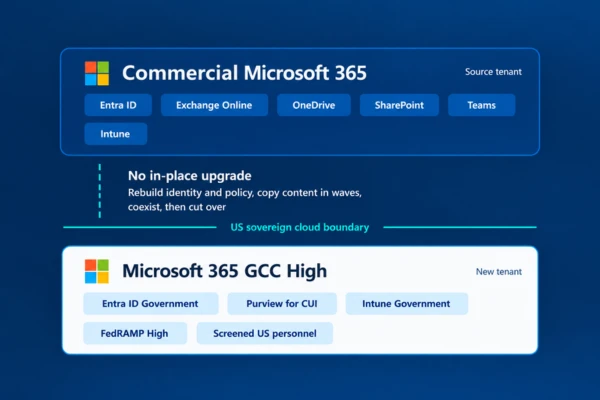
GCC High is a separate cloud with its own Entra ID directory and its own service endpoints. Nothing connects your commercial tenant to it automatically. Every workload is rebuilt or copied, and each one affects users differently.
Identities
What happens
Accounts are recreated in Entra ID Government. With on-premises Active Directory, Microsoft Entra Connect can sync to both tenants during coexistence.
Plan for
Users register MFA again in the new directory. Conditional Access is rebuilt, not copied.
Exchange Online
What happens
mailboxes are pre-staged with third-party tooling and synced incrementally. The domain moves to GCC High at cutover.
Plan for
Outlook profile rebuilds; MX, Autodiscover, SPF and DKIM changes; recurring Teams meetings recreated because old meeting links stop working.
Mailbox permissions
What happens
Microsoft does not support mailbox and calendar permissions across tenants.
Plan for
Delegates and the mailboxes they use move in the same wave.
OneDrive
What happens
Content is copied with third-party tooling. Microsoft’s cross-tenant OneDrive migration is not supported for GCC High.
Plan for
Existing sharing links break and must be re-shared.

SharePoint
What happens
Sites are rebuilt around a CUI boundary, and content is copied into the new tenant.
Plan for
URLs change, so bookmarks, embedded links and hard-coded connections need updating.

Teams
What happens
Teams, channels and files are rebuilt in the new tenant with third-party tooling.
Plan for
How much chat history moves depends on the tool. We agree it with you before migration starts.
Devices
What happens
Entra-joined, Intune-managed devices are re-enrolled into Intune Government.
Plan for
Existing sharing links break and must be re-shared.
Purview policy
What happens
Sensitivity labels cannot be shared between tenants, so labels and policies are recreated.
Plan for
A label design aligned to CUI marking, built before content lands.
Microsoft documents that cross-tenant mailbox migration does not support cross-cloud moves, and that cross-tenant OneDrive migration is not supported for GCC High. A commercial to GCC High migration therefore runs on third-party tooling chosen per workload.
GCC High tenant migration scenarios we deliver
The pattern determines tooling, sequence and timeline.
Commercial Microsoft 365 to GCC High
A new GCC High tenant, a coexistence period, and a managed cutover of mail, OneDrive, SharePoint and Teams.
Commercial
→
GCC High
CUI enclave alongside commercial
Only the people and processes that handle controlled data move. The rest of the business stays in commercial Microsoft 365.
CUI users
→
GCC High enclave
On-premises and legacy platforms to GCC High
Exchange and SharePoint Server, file shares, Box, Google Workspace, OpenText and Documentum content moved into the government cloud.
On-premises
→
GCC High
GCC High to GCC High tenant consolidation
Merging government tenants after an acquisition, or folding an enclave into a primary tenant. Identity, domains and content still move.
GCC High A
→
GCC High B
Divestiture carve-out to a new GCC High tenant
Data entitlement, split repositories and holds, a new tenant under its own sponsorship, a transition services period, and documented severance.
Parent tenant
→
New GCC High
For divestitures, our mergers and acquisitions IT practice runs the wider separation plan around the tenant carve-out.
CUI enclave or full tenant?
An enclave moves fewer users, less data and fewer devices than a full-tenant migration. Whether you need to move the whole company is the first question we answer.
CUI enclave
Only the people and processes that handle controlled data move.
Full tenant
Everyone moves, and there is one compliance boundary to operate.
Users in GCC High
Users staying in commercial Microsoft 365
How our GCC High migration method works
Every engagement uses the same six stages. The scenario decides which are in scope and in what order.
01
Assess and decide
We confirm whether you need GCC High, GCC or commercial Microsoft 365, settle the enclave versus full tenant question, map where controlled data lives, and produce a priced migration roadmap before you commit to a program.
02
Build the target tenant
Microsoft eligibility validation, the licensing path, Entra ID Government build, domain strategy, hybrid identity, break-glass accounts and a US-persons administrative model. Outputs include a System Security Plan, a Customer Responsibility Matrix and NIST SP 800-171 control mapping, led by our identity and governance team.
03
Secure the tenant before data lands
Controls go in before content arrives, drawing on our security and compliance practice and data protection with Purview.
- Identity and access
- Purview for CUI
- Threat protection
- Endpoints
04
Migrate in waves, with coexistence
A pilot wave first, then production waves sized by business unit and data dependency. Content is pre-staged and synced incrementally so each cutover moves only the final changes. Delegates and the mailboxes they use move together. The approach comes from our Microsoft 365 migration practice.
05
Cut over and stabilize
Domain move, DNS changes, final sync, device re-enrollment, user support and CUI handling training. For controlled collaboration with primes, subcontractors and auditors, we deploy Govern 365, our virtual data room and workspace governance platform built on SharePoint, Entra ID and Purview.
06
Run
Tenant operations, compliance drift monitoring, control evidence and government cloud roadmap tracking by US-based staff, through our Microsoft 365 managed security services. Feature availability in GCC High differs from commercial Microsoft 365, so we track what has arrived and what it changes for you.
What sets the timeline of a GCC High migration
Microsoft eligibility validation comes before the GCC High tenant is provisioned, so the schedule starts before any data moves. After that, four factors set the calendar. Program Discovery turns them into a firm schedule for your environment.
Scope
A CUI enclave moves a defined group. A full tenant moves everyone.
Data volume
Mailbox, OneDrive and SharePoint content determines how long pre-staging takes.
Teams complexity
The number of teams, channels and external collaborators shapes the rebuild.
Device count
Every managed device is re-enrolled, so device numbers set the size of each wave.
What can go wrong in a GCC High migration
We would rather you hear these from us during scoping than discover them during cutover.
Eligibility comes first
Microsoft validates eligibility before the tenant exists. The technical build cannot start until it completes.
Features differ from commercial
Some capabilities your users rely on today may not yet exist in GCC High. We map the gaps during assessment.
Links and bookmarks break
New tenant, new URLs. We inventory high-traffic links and embedded references; some updates fall to site owners.
Some things are rebuilt, not moved
Sensitivity labels cannot be shared between tenants, Teams meeting links stop working, and chat history depends on the tool. We list every rebuild item before migration starts.
Every user feels the cutover
MFA registration, Outlook profile rebuilds and device re-enrollment apply to everyone who moves. We plan help desk capacity and user instructions for each wave.
Microsoft 365 Copilot after your GCC High migration
The constraint is data readiness. A GCC High migration is the natural point to fix permissions and apply labels, because content is being restructured anyway. Our AI security and governance team handles it before Copilot is switched on.
Available
Microsoft 365 Copilot in GCC High since December 2025
Default setting
Copilot Chat web grounding is off by default in GCC High
Not offered
Microsoft Security Copilot is not designed for US government clouds
Step 1
Find overshared
content
Step 2
Fix SharePoint
permissions
Step 3
Label CUI
Step 4
Set agent
governance
Step 5
Enable Copilot
The Netwoven Advantage
Why Netwoven for GCC High migration
Proven Migration Expertise
Most GCC High specialists are compliance consultancies that learned to configure a tenant. Netwoven is a Microsoft engineering firm with 1M+ users migrated and 2,500+ projects delivered, applying that discipline inside the government boundary.
US-based delivery team.
More than twenty US-based consultants and engineers deliver GCC High engagements. Controlled data is handled by US persons, with a documented administrative and access model.
Microsoft Solutions Partner across all six domains.
Direct access to Microsoft's engineering organization, with Copilot and Modern Work specializations.
Full lifecycle accountability.
Assessment, architecture, migration, adoption, and ongoing managed services under one accountable partner.
Start with a fixed-price GCC High migration assessment
Scope sets most of the cost, so we price the decision before the program. Each entry engagement produces a decision document and a priced roadmap.
| Engagement | Duration, on a 0 to 6 week scale | Output |
|---|---|---|
| GCC High Fit and Eligibility Assessment |
2 to 3 weeks
| Whether you need GCC High, GCC or commercial Microsoft 365; eligibility path, option set, cost model |
| Enclave vs. Full Tenant Workshop |
2 weeks
| Scope boundary, user and data segmentation, comparative total cost of ownership |
| CUI Data Landscape Assessment |
3 to 4 weeks
| Where controlled data lives, volume and complexity model, migration wave plan |
| GCC High Migration Program Discovery |
4 to 6 weeks
| Full architecture, tooling, wave plan, System Security Plan outline, firm-priced program |
GCC High migration FAQs
A GCC High migration moves users, mailboxes, files, Teams and identities from another environment, usually commercial Microsoft 365, into a separately provisioned Microsoft 365 GCC High tenant. GCC High is a US sovereign cloud with data in US datacenters managed by screened US personnel, and it holds FedRAMP High authorization. Because the clouds are separate, the move is a rebuild and copy, not an upgrade.
No. Microsoft does not support cross-cloud tenant-to-tenant migration, such as moving from Office 365 worldwide to a government cloud, and there is no in-place conversion. You provision a new GCC High tenant, rebuild identity and policy, copy content with third-party tooling, run a coexistence period, and move your domain at cutover.
It depends on scope. Microsoft eligibility validation comes before the GCC High tenant is provisioned, so the schedule starts before any data moves. After that, the number of users moving, data volume, Teams complexity and device count set the timeline. Our Program Discovery engagement produces a wave plan and a firm schedule for your environment.
Scope is the biggest cost driver. A CUI enclave moves fewer users, less data and fewer devices than a full-tenant migration, so we settle that decision first. Licensing, the number of workloads and the length of coexistence drive the rest. Our fixed-price Fit and Eligibility Assessment produces an option set and a cost model for your organization.
It depends on your contract clauses and the data you handle, including whether you hold CUI or ITAR and EAR controlled technical data. GCC High is built for those workloads, but not every defense supplier needs it for every user. Our Fit and Eligibility Assessment reviews your clauses and data, then recommends GCC High, GCC or commercial.
Microsoft’s native cross-tenant mailbox migration does not support cross-cloud moves, and its cross-tenant OneDrive migration does not support GCC High. Commercial to GCC High migrations therefore use third-party tools that support government endpoints for mail, OneDrive, SharePoint and Teams. We select tooling per workload after discovery and prove it in a pilot wave.
Not for long. During coexistence, users keep working in the commercial tenant while content is pre-staged and synced into GCC High. At cutover the domain moves, mail routing switches and a final sync runs, typically outside business hours. Users then sign in to the new tenant, rebuild their Outlook profile and use new SharePoint and OneDrive links.
Yes. GCC High to GCC High tenant consolidation and divestiture carve-outs are both scenarios we deliver. Staying inside the government cloud does not remove the work: identity, domains and content still move. For divestitures we also determine data entitlement, separate shared repositories and holds, stand up the new tenant under its own sponsorship, and document severance.
Usually not. The July 2026 suspension paused the expansion of third-party CMMC assessments. DFARS 252.204-7012 safeguarding, NIST SP 800-171 self-assessment and CMMC Phase 1 requirements remain in force, as do ITAR and EAR obligations, and prime contractors still flow down CUI protection requirements. Treat the pause as time to plan properly.
Yes. Microsoft 365 Copilot became available in GCC High in December 2025. Copilot Chat web grounding is off by default there. Microsoft Security Copilot is not designed for US government clouds. The practical prerequisite is data readiness: permission cleanup and sensitivity labeling before enablement, which fits naturally into the migration.
Start your digital transformation with confidence
Whether you're planning a migration or optimizing your environment, our experts are here to help you move faster and more securely.
Prefer to call?
+1-877-638-9683Drop us a mail
info@netwoven.comSchedule a Capability Discovery Call
🔒 No spam. Your information stays private.