

Introduction
2025 is a pivotal year for identity security. AI that creates content and autonomous agents have made identity attacks more powerful. These attacks now happen quicker, on a larger scale, and are tougher to spot. Cyber criminals use deep-fake videos to commit fraud, create fake identities, and use AI to make their phishing more effective. They target identity systems because they see them as the weak spot in enterprise security. While AI strengthens defenders, attackers still have the upper hand with AI. This has led to new risks centered on identity that companies need to tackle right away.
This report gives key insights, shows current threat patterns, and offers clear steps to CISOs, IAM heads, and security leaders. It aims to help them boost identity security as AI makes threats more dangerous.
Key Findings

AI-Powered Identity Attacks Surge
92% of organizations agree that AI-driven cybercrime has intensified risk, with phishing and social engineering leading entry points for ransomware campaigns.
Source: spycloud.com
Deepfake Fraud Hits Enterprises
Over 2,000 verified deepfake incidents targeted businesses in Q3 2025, including executive impersonation and fraudulent wire transfers.
Source: newsweek.com
Synthetic Identities on the Rise
Generative AI enables the creation of highly convincing fake IDs and biometric fraud, bypassing traditional verification systems.
Source: entrust.com
Scale of Impact
Identity theft reports in the U.S. exceeded 6.4 million cases in 2025, with median losses per victim remaining steady at $497.
Source: security.org
Confidence Gap
While 86% of security leaders feel prepared, 85% of organizations were still impacted by identity-based attacks in 2025.
Source: spycloud.com
The AI Identity Threat Landscape
Generative AI-Driven Phishing
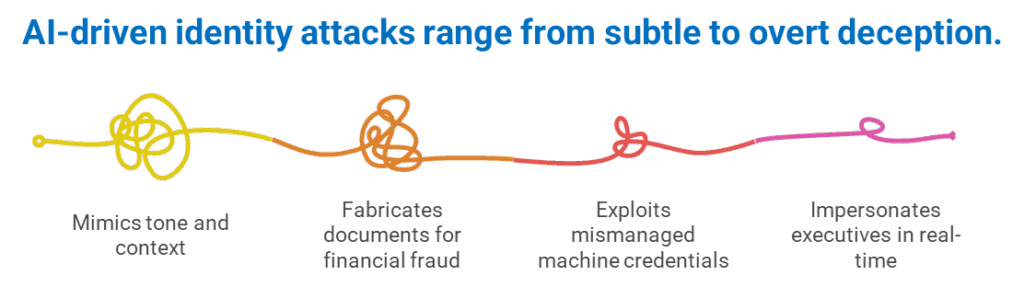
AI-generated phishing emails now mimic tone, logos, and context with near-perfect accuracy, bypassing legacy filters. Attackers use adaptive language models to personalize lures at scale.
Source: truthscan.com
Deepfake & Voice Cloning Attacks
Fraudsters weaponize video and audio deepfakes to impersonate executives, authorize transactions, and manipulate trust in real-time.
Source: newsweek.com
Synthetic Identity Fraud
AI creates fake identities using stolen SSNs and fabricated documents, enabling large-scale financial fraud and account takeovers.
Source: entrust.com
Machine Identity Exploits
Non-human identities now outnumber human identities, creating blind spots in authentication systems. Attackers exploit mismanaged machine credentials to move laterally across networks.

Emerging Mitigation Strategies
AI-Powered Identity Governance
Deploy adaptive IAM frameworks with continuous risk scoring, behavioral biometrics, and automated privilege de-escalation.
Source: forbes.com
Deepfake Detection & Verification
Integrate media authentication and biometric validation into onboarding and transaction workflows.
Source: newsweek.com
Zero-Trust + AI Risk Modeling
Combine zero-trust principles with AI-driven anomaly detection to secure hybrid and multi-cloud environments.
Source: dailysecurityreview.com
Agentic AI Oversight
Treat AI agents as digital identities with credentials, policies, and continuous monitoring to prevent rogue actions.
Strategic Recommendations for CISOs

Modernize Identity Infrastructure
- Adopt passwordless/strong authentication (FIDO2, Passkeys, Windows Hello for Business).
- Implement continuous access evaluation (CAE).
- Enforce privileged access workstations (PAWs).
Strengthening Human Identity Assurance
- Use advanced liveness detection for high-risk approvals.
- Implement dual human verification for large financial transactions.
- Train staff using synthetic deepfake examples.
Invest in ITDR Capabilities
- Deploy AI-driven identity analytics.
- Continuously monitor privileged identity behavior.
- Conduct monthly identity attack simulations.
Enhance Supply Chain Identity Security
- Apply Zero Trust access for vendors/suppliers.
- Require MFA + device trust for all contractors.
- Monitor non-human identities and service accounts.
Conclusion
2025 marks a turning point where Generative AI no longer just accelerates traditional cyberattacks but creates new identity-centric threats at scale. Organizations that modernize identity security particularly through advanced verification, passwordless authentication, and ITDR will be best positioned to operate securely in the AI era.