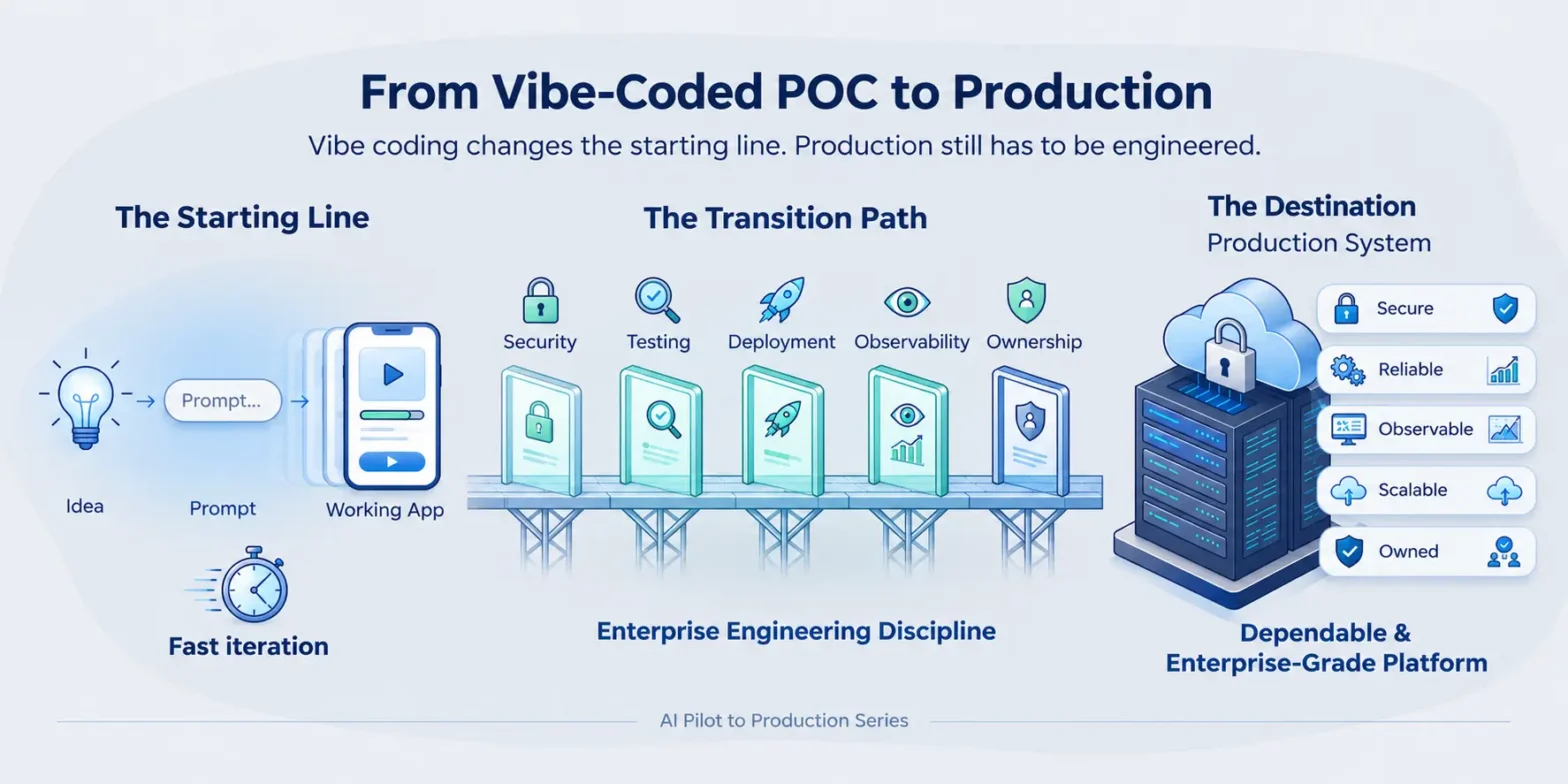
Enterprise AI doesn’t have a model problem. It has a production problem. Something fundamental changes when AI leaves the lab.
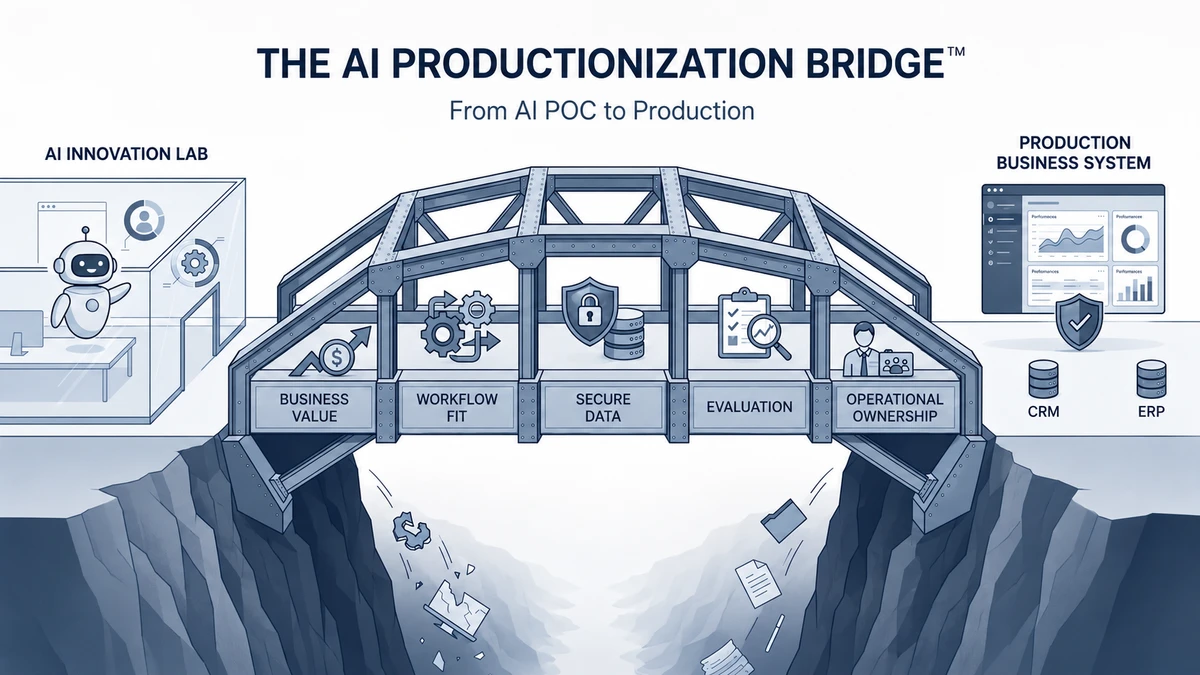
Key takeaway. Moving an AI pilot to production requires five things to mature around the model: measurable business value, fit with real human workflows, secure and reliable enterprise data, continuous evaluation, and clear operational ownership. Netwoven calls these five requirements the AI Productionization Bridge™.
Every enterprise team I speak with seems to have an impressive AI story.
A knowledge assistant that answers difficult questions. A Copilot that summarizes hours of work in seconds. An agent that can navigate a business process that previously required several people and multiple systems.
The demos work. The technology is impressive. The enthusiasm is genuine.
And then something interesting happens.
As the conversation turns toward production, the questions change.
Nobody is asking whether the model can summarize a document anymore. They are asking who is allowed to see that document.
Nobody is asking whether the agent can update the CRM. They are asking what happens when it updates the wrong record.
Nobody is asking how impressive the answers looked in the demonstration. They are asking how we will know those answers are still reliable after the model, prompts, knowledge sources, permissions and business rules have changed six months later.
Who owns this once the project team leaves?
I have seen that transition enough times that I no longer think of it as an implementation detail.
Something fundamental changes when AI leaves the lab.
Why do so many AI PoCs fail to reach production?
Short answer. AI pilots stall because production demands conditions a proof of concept never tests: permission-safe data, workflow fit, continuous evaluation, sustainable economics and a named owner. Adoption is nearly universal; scaling is not.
The industry data increasingly reflects the same pattern.
McKinsey’s 2025 State of AI research found that 88% of organizations were using AI in at least one business function. Yet most organizations had still not scaled AI across the enterprise.
S&P Global found an even more revealing pattern. The proportion of organizations abandoning the majority of their AI initiatives before production increased from 17% to 42% year over year. On average, organizations reported scrapping 46% of projects between proof of concept and broad adoption.
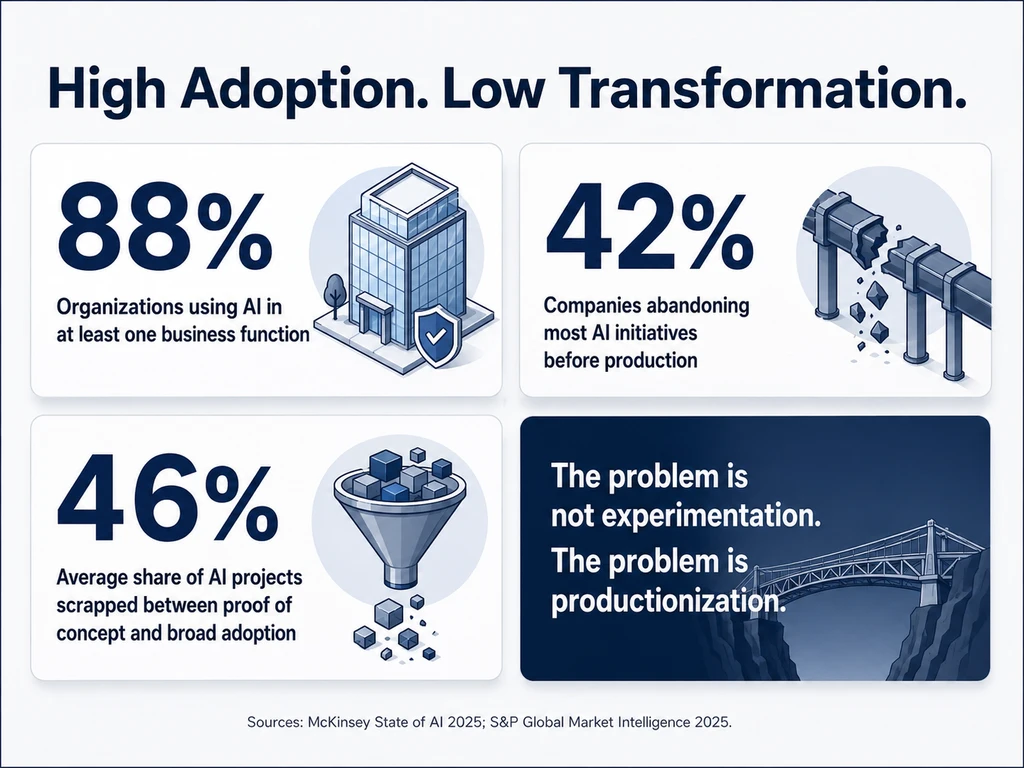
Those numbers do not tell me that AI is failing.
They tell me that experimentation and production are different disciplines.
For much of the last few years, the enterprise AI conversation has revolved around one question:
Can AI do this?
Can it understand the contract? Can it answer an employee’s question? Can it analyze the financial data? Can an agent execute the workflow?
Those were important questions when the capabilities themselves were uncertain. But foundation models have improved dramatically. Enterprise AI platforms have matured. Retrieval-Augmented Generation, copilots, agents and orchestration frameworks have made it much easier to demonstrate sophisticated AI behavior.
The harder question now is:
Can this become a dependable business system?
That sounds like a small change in wording. It isn’t.
What changes when an AI POC moves to production?
Short answer. A POC proves technical feasibility. Production must prove value, security, reliability, economics and ownership. They are different disciplines that ask different questions.
During a proof of concept, the objective is normally technical feasibility: prove that the AI can perform the task.
Production forces a different set of questions.
A POC may prove that an architecture works at a few hundred requests. Production has to prove that the architecture still works technically and economically at enterprise scale.
That is why moving from AI POC to production is not simply the final phase of an AI project. It is a change in engineering discipline.
Is the AI use case valuable enough to productionize?
Short answer. Before productionizing, confirm the workflow is frequent, measurable and important enough to fund—and that a named business owner is accountable for the outcome.
Many organizations no longer suffer from a shortage of AI ideas. They suffer from too many.
Dozens of pilots compete for data, people, funding and executive attention. Some are started because the technology is interesting. Others because competitors appear to be investing. Still others because a platform license suddenly makes experimentation easy.
But every successful pilot should not become a production system.
Production requires a much higher standard. What business outcome will improve? How will that outcome be measured? What is the economic value of the improvement? Is this use case important enough to justify production engineering, integration, security, change management and ongoing operations?
That makes strategic focus part of AI productionization.
Does the workflow need redesign before AI automation?
Short answer. AI applied to a broken process automates the inefficiency. Production requires redesigning the workflow and involving the people who perform the work.
It is tempting to take an existing process and add AI to it. Sometimes that creates enormous value. Sometimes it simply automates process waste.
Before asking how an agent can automate a workflow, it is worth asking whether the workflow itself still makes sense. Where does human judgment genuinely add value? Which steps are deterministic? Which steps exist because of historical system limitations? Where are approvals necessary because of actual risk rather than organizational habit?
And, critically, have the people who perform this work been involved in designing the new process?
Employees rarely want another AI application. They want their existing work to become easier. Human-in-the-loop therefore cannot mean simply placing an approval button at the end of an agent workflow. It has to be part of the workflow design itself.
Is enterprise data ready and safe for AI?
Short answer. In production the question shifts from “can the AI access this data?” to “should this user see this data through AI?” Retrieval must enforce existing enterprise permissions.
Data readiness is often discussed as though it means connecting enough repositories to a RAG pipeline. Production makes the problem much harder.
Enterprise data is fragmented across generations of technology. It is duplicated. Metadata is inconsistent. Some information is stale. Access models may have evolved over years.
AI does not eliminate those problems. It exposes them.
A knowledge assistant can perform beautifully against a curated dataset and still be impossible to deploy broadly if the organization cannot guarantee that retrieval respects real-world security boundaries.
Can it find the right information, for the right user, from the right source, under the right permissions?
How do you continuously evaluate AI in production?
Short answer. Demo impressions are not an evaluation strategy. Production AI needs representative test sets, regression testing and explicit human-review thresholds so quality stays measurable as the system changes.
During experimentation, looking at a collection of responses and asking “Does this look right?” may be perfectly reasonable. At production scale, it is not enough.
What happens when the underlying model changes? When a prompt is modified? When a retrieval configuration changes? When a knowledge repository is reorganized? When an agent gets access to a new tool? When business policy changes?
Production AI needs a continuous evaluation discipline: representative test sets, regression testing, measurable quality thresholds, observable failure categories, guardrails and explicit points where human judgment is mandatory.
The objective is not to make generative AI perfectly deterministic. It is to make its behavior measurable enough to trust.
Can the AI system operate economically at enterprise scale?
Short answer. Cost per successful transaction is an architecture decision. Deterministic logic should handle whatever does not require a model.
There is another production problem that receives far less attention than it should: economics.
A pilot may process a few hundred requests. A production application may eventually process millions. Token consumption, model selection, agent loops, retrieval calls, observability, infrastructure and compute all become part of the unit economics of the solution.
Does every request require an LLM? Could deterministic software handle part of the workflow? Does every task require the most capable model? How many times should an agent be allowed to iterate? What is the cost per successful business transaction?
In one production agent our team built for a semiconductor enterprise, roughly 85% of incoming requests are resolved deterministically, with no model call at all. Deterministic routing handles what deterministic logic should handle; the model is reserved for work where reasoning, language understanding or synthesis actually creates value.
That architectural choice is a major reason the solution’s cost per transaction remains predictable as volume grows.
A technically successful AI application that cannot operate economically is not production-ready.
Who owns the AI system after go-live?
Short answer. Someone must own quality, cost, data freshness, evaluation and change after go-live. Without that owner, a live AI system degrades quietly.
Traditional project thinking assumes that deployment represents completion. Production AI turns that assumption upside down.
The knowledge changes. Models change. Prompts change. Permissions change. Business processes change. Costs change. Users discover edge cases. Evaluation datasets themselves become outdated.
Somebody has to own all of that.
Operational ownership means treating an AI application as a living business system rather than a completed development project. That ownership covers reliability, security, integration health, evaluation, data freshness, model and prompt changes, incident response, infrastructure, cost and—most importantly—whether the system continues delivering the business outcome for which it was created.
What is the AI Productionization Bridge™?
Over time, I began noticing that these production problems were not random.
One initiative had excellent AI but no measurable business outcome. Another had a strong business case but lived outside the users’ natural workflow. Another worked beautifully until enterprise permissions were introduced. Another struggled because nobody could objectively determine whether model changes had improved or degraded the experience.
The image that eventually made the most sense was a bridge.
Not a bridge between old technology and new technology.
A bridge between building AI and operating AI.
These are not five sequential project phases. They are structural elements of the production system. Remove one of those spans and the bridge becomes weaker. Ignore several and the crossing from AI pilot to production may never happen.
Why does agentic AI make production readiness even more important?
Short answer. Agents act rather than answer, so weak production discipline stops being disappointing and starts being consequential.
Agentic AI raises the stakes.
A conventional AI assistant may produce a poor answer. An agent can potentially act on one.
As AI shifts from answering questions to calling tools, updating enterprise applications and orchestrating workflows, weak production discipline becomes much more consequential. Identity matters more because agents act on behalf of users. Evaluation matters more because outputs become actions. Human oversight matters more because some decisions should never be fully autonomous. Infrastructure and observability matter more because a failure can propagate across systems.
Agentic AI does not remove the AI productionization problem. It amplifies it.
What does production-ready enterprise AI look like?
Short answer. Production-ready enterprise AI delivers measurable value, fits real workflows, respects entitlements, can be evaluated as it evolves, remains economically viable at scale, and has an accountable owner.
The next phase has to demonstrate that AI applications can become dependable business systems: systems that create measurable business value, systems people actually use, systems that know what information users are entitled to access, systems whose behavior can be evaluated as they evolve, systems that remain economically viable at scale, and systems that somebody is accountable for operating.
That is a very different definition of AI success.
Not: “How intelligent is this?”
But: “Can the business depend on it?”
The organizations that answer that question well will create far more sustainable value from AI than those that simply build the greatest number of pilots or adopt the newest models first.
Because the next chapter of enterprise AI will not be won in the demo.
It will be won in production.
Enterprise AI doesn’t have a model problem.
It has a production problem.
AI Pilot to Production: Frequently Asked Questions
AI productionization is the process of turning a technically successful AI prototype or POC into a dependable business system that delivers measurable value under real enterprise conditions. It includes workflow integration, enterprise data and identity, evaluation, governance, security, operational economics and long-term ownership—not simply deploying a model endpoint.
AI pilots commonly stall because the requirements that determine production success were never tested during the POC. These can include unclear business value, poor workflow fit, fragmented or permission-sensitive data, inadequate evaluation, weak integration, unsustainable operating cost and the absence of a long-term owner.
An AI POC primarily proves technical feasibility: whether AI can perform a task. Production AI must prove that the capability is valuable, secure, reliable, economically sustainable, integrated into real workflows and operable over time.
The AI Productionization Bridge™ is Netwoven’s framework for moving enterprise AI from pilot to production. It focuses on five production disciplines: Business Value, Workflow Fit, Secure Data, Evaluation and Operational Ownership.
A production-readiness assessment should examine the business outcome, workflow and user adoption, enterprise data and permission model, evaluation approach, integration architecture, infrastructure and security, operating economics, governance and post-launch ownership.
Part 2: The Eight Failure Modes That Stall AI Pilots Before Production
Why technically successful AI initiatives break down—and how to spot the failure patterns before they derail production.