How a Reasoning Layer Enables Better Enterprise Decisions
Every enterprise AI agent eventually faces the same challenge.
A user asks what appears to be a simple business question.
“Which of our products will be affected if one of our key suppliers cannot deliver for the next four weeks?”
Answering that question isn’t difficult because the data is unavailable.
Modern AI platforms can already connect to SAP, Microsoft 365, ServiceNow, Salesforce, and virtually any enterprise application through APIs, connectors, or standards such as MCP.
The challenge is something else.
How does the AI decide what to do next?
Should it query every available system?
Should it check inventory before finance?
Does it need customer order data at all?
Should external news be considered before calculating business impact?
Every one of those decisions influences the quality, speed, cost, and reliability of the final answer.
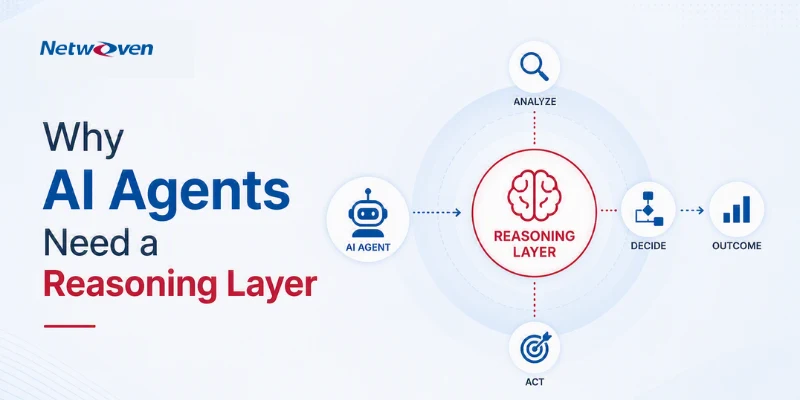
This is exactly why enterprise AI agents need a Reasoning Layer, a capability that enables them to understand the business objective, determine which information is actually required, plan the sequence of actions, and justify every decision they make.
The rest of this article explores why that capability is becoming one of the most important architectural building blocks in enterprise AI.
What Is a Reasoning Layer?
A Reasoning Layer is the decision-making capability that sits between the language model and enterprise systems.
Rather than immediately invoking every available tool, it first interprets the user’s objective, evaluates business context, determines which systems are required, plans an execution strategy, and only then retrieves information.
Think before you act.
1. Business Scenario
Imagine you’re the Procurement Director of a manufacturing company.
A critical supplier has just announced a factory shutdown due to flooding.
You ask your enterprise AI assistant:
“Which of our products will be affected if this supplier cannot deliver for the next four weeks, and what should we do?”
To answer accurately, the AI may need information from multiple enterprise systems:
• SAP ERP – Supplier contracts, purchase orders, inventory
• Manufacturing – Bill of Materials (BOM)
• Inventory System – Current stock levels
• Logistics – Shipments already in transit
• CRM – Customer orders
• Finance – Financial impact
• External News – Duration and severity of disruption
One business question. Seven enterprise systems.
Procurement is just one example. The same pattern repeats across nearly every enterprise function. A customer service agent resolving a billing dispute may need CRM, billing, and contract data but not always all three. A finance team closing the books each month may need to validate transactions across the general ledger, accounts payable, and bank reconciliation systems, escalating to treasury or audit tools only when discrepancies appear. An IT support agent diagnosing an outage may need monitoring dashboards, change logs, and asset inventories, and only in a sequence that depends on what the first system reveals. In every case, the number of available tools is large, but the number of tools genuinely needed to answer a given question is small. Identifying that smaller set, and the right order to use it in, is the job of a reasoning layer.
2. Scenario 1: Without a Reasoning Layer
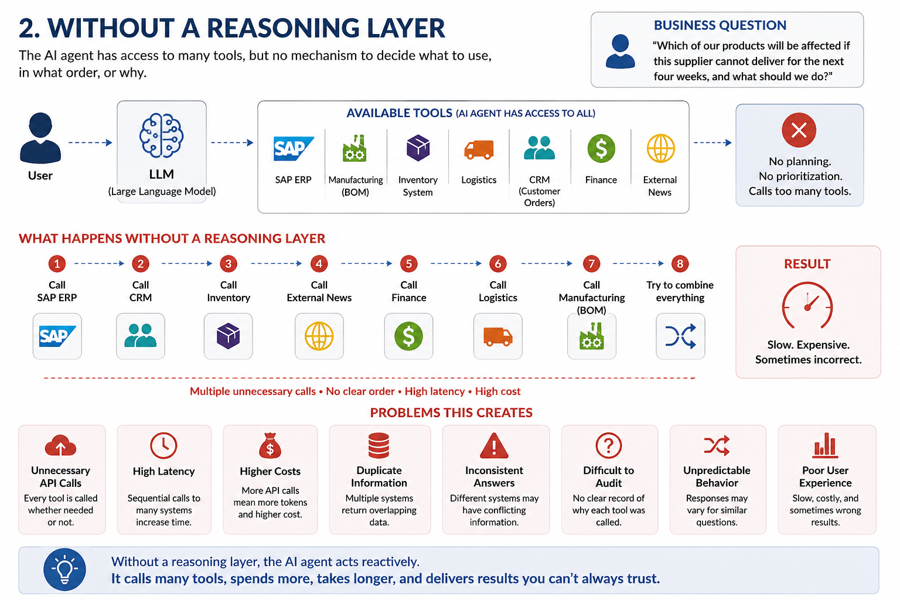
Without structured reasoning, every connected system appears potentially relevant.
Instead of determining what information is actually needed, the AI begins retrieving data immediately.
It queries SAP, then CRM, Inventory, Logistics, Finance, Manufacturing, and External News. Only after collecting everything does it attempt to determine what actually matters.
This ‘retrieve first, think later’ approach increases API consumption, token usage, latency, infrastructure cost, and governance complexity. Different systems may return overlapping or conflicting information, making recommendations harder to trust.
At enterprise scale, this quickly becomes expensive, unpredictable, and difficult to govern.
3. Scenario 2: With a Reasoning Layer
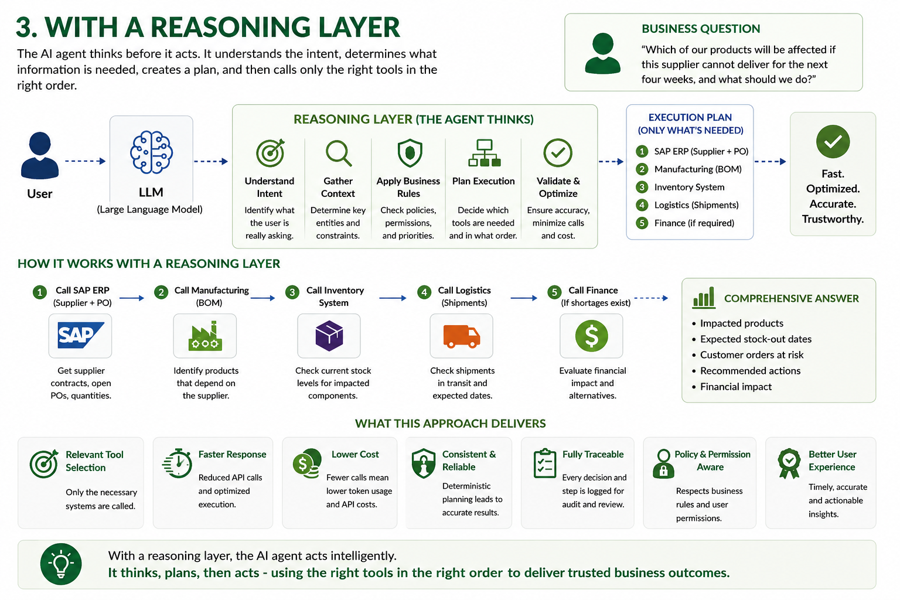
Now consider the same business question with a Reasoning Layer.
The connected systems haven’t changed. What changes is how the AI approaches the problem.
Instead of immediately retrieving data, the Reasoning Layer first asks:
“What is the business trying to accomplish?”
It identifies three objectives:
• Determine impacted products
• Assess business impact
• Recommend mitigation actions
It then creates an execution plan:
1. Retrieve supplier information from SAP.
2. Identify affected products using the Bill of Materials.
3. Check inventory.
4. If inventory is insufficient, retrieve logistics information.
5. Only if disruption remains likely, retrieve financial information.
Every API call has a purpose. Every decision is explainable. Every action follows a logical sequence.
4. Why This Matters
The difference is not that the AI becomes smarter, it becomes more disciplined.
Without a Reasoning Layer, the AI behaves like someone who gathers every available document before deciding which ones matter.
With a Reasoning Layer, it behaves like an experienced business analyst who first understands the problem, determines what information is required, and retrieves only what is necessary.
For enterprise organizations, that distinction directly impacts cost, performance, governance, security, and user trust.
| Capability | Without a Reasoning Layer | With a Reasoning Layer | Business Impact |
| Tool Selection | The AI invokes most or all available tools because each one appears potentially relevant. | The reasoning layer identifies only the systems required to answer the user’s question. | Reduces unnecessary integrations, minimizes API consumption, and improves overall efficiency. |
| Execution Strategy | Tool calls begin immediately without a defined plan. | The AI first understands the request, determines dependencies, and creates an execution plan before invoking any systems. | More predictable workflows with fewer unnecessary operations. |
| API & Token Consumption | Every additional tool call generates more API requests and consumes more LLM tokens. | Only relevant systems are queried, significantly reducing API usage and token consumption. | Lower infrastructure costs and better scalability for enterprise deployments. |
| Response Time | Sequential calls across multiple systems increase overall latency. The response is only generated after all systems have been queried. | Only the required systems are accessed, and conditional execution avoids unnecessary requests. | Faster responses and a better end-user experience. |
| Decision Quality | Information is gathered first and interpreted afterward, increasing the likelihood of irrelevant or conflicting data influencing the answer. | Each step is validated before moving to the next, ensuring that only relevant information contributes to the final response. | Higher-quality recommendations and more accurate business decisions. |
| Data Retrieval | Multiple systems often return overlapping or duplicate information that must be reconciled later. | Information is retrieved progressively and only when needed. | Reduced processing overhead and cleaner data synthesis. |
| Governance & Explainability | It is difficult to explain why specific tools were invoked or how the final answer was produced. | Every decision- from intent recognition to tool selection and execution- is traceable and can be logged for audit purposes. | Supports compliance, governance, and enterprise audit requirements. |
| Security & Permissions | Sensitive systems may be queried unnecessarily, increasing exposure to confidential information. | The reasoning layer evaluates permissions and business policies before accessing enterprise systems. | Improved security posture and reduced risk of unauthorized data access. |
| Adaptability | Every similar request often follows the same retrieval pattern regardless of the context. | The execution plan adapts dynamically based on intermediate results and business context. | More intelligent and context-aware AI behavior. |
| Business Outcomes | Responses may vary depending on the order and volume of retrieved information, resulting in inconsistent recommendations. | The AI follows a structured, policy-driven decision process, producing consistent and repeatable outcomes. | Greater trust in AI-generated recommendations and increased user confidence. |
5. Where Microsoft Copilot Studio Fits
Microsoft Copilot Studio already provides powerful LLM-based reasoning capabilities. It understands natural language, maintains conversational context, invokes connected tools, and orchestrates many business scenarios effectively.
For simple business requests, such as checking leave balances, summarizing documents, or updating CRM records – its native orchestration is often sufficient.
However, enterprise processes frequently require organization-specific decision logic, business policies, compliance rules, conditional execution, cross-system planning, and auditability.
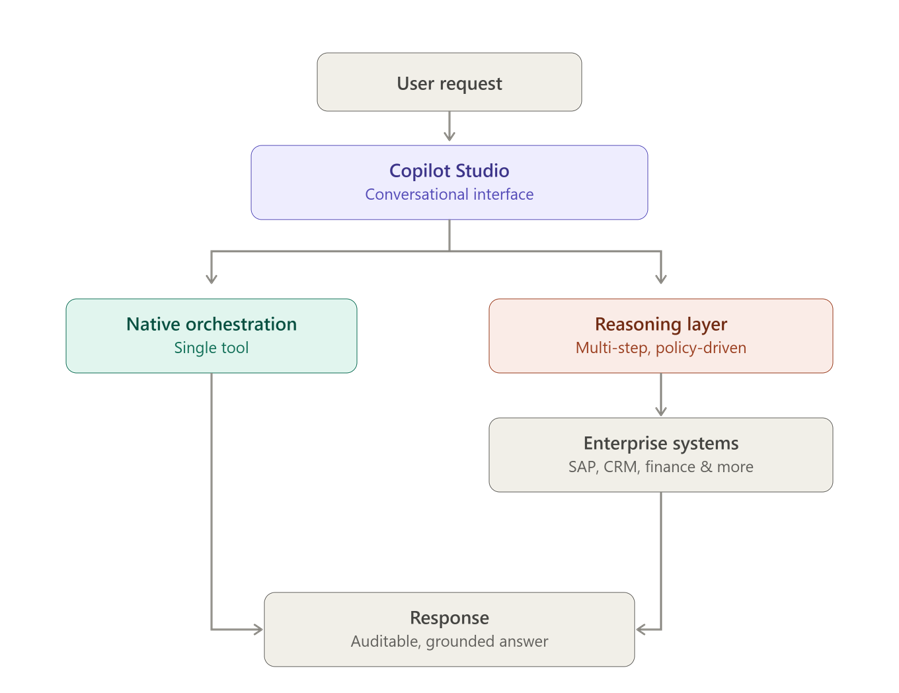
In these scenarios, architects extend Copilot Studio with a Reasoning Layer, not to replace it, but to provide explicit business decision-making and governance.
Copilot Studio remains the conversational interface.
The Reasoning Layer becomes the enterprise decision engine.
Conceptually, the architecture looks like this:
6. Conclusion
Enterprise AI is entering a new phase. The challenge is no longer connecting AI to enterprise systems – modern APIs, connectors, and protocols such as MCP have largely solved that problem.
The real challenge is enabling AI to make the right decisions once those connections exist.
A reasoning layer helps bridge this gap by interpreting user intent, planning execution, enforcing business policies, and orchestrating enterprise systems in a secure, explainable, and governed manner. Instead of simply invoking every available tool, it enables AI agents to make deliberate, context-aware decisions that align with organizational objectives.
Platforms such as Microsoft Copilot Studio already provide powerful LLM-based reasoning and orchestration capabilities. However, as business processes become more complex, organizations often need to extend these capabilities with enterprise-specific decision logic, governance, and policy enforcement. This is where a reasoning layer adds lasting value—not by replacing the AI platform, but by ensuring that AI decisions remain consistent, compliant, and aligned with business rules.
As enterprises continue to adopt AI agents across critical business functions, success will be measured not by how many systems an AI can access, but by how intelligently, responsibly, and transparently it uses them.
Ultimately, the future of enterprise AI belongs to agents that don’t just execute tasks, they understand the business, reason through complex decisions, and act with the same discipline, governance, and accountability expected from every enterprise system.
If you’re evaluating whether your Copilot Studio agents need an enterprise reasoning layer or you’re further along and need help designing one – Netwoven’s AI and automation team can help you assess your current agent architecture and map out the right next step.