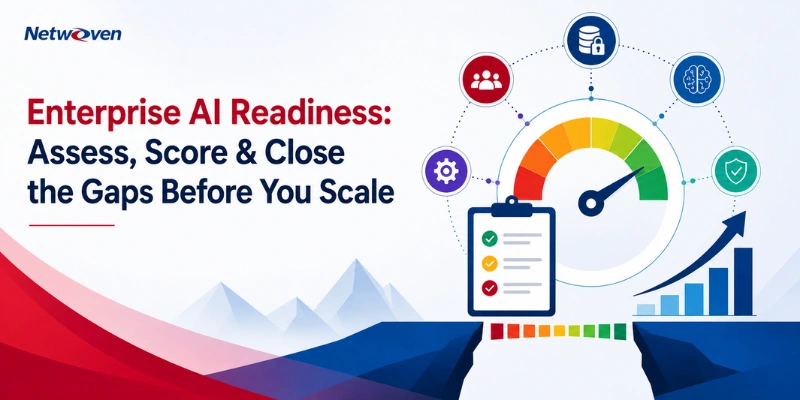
Most organisations measure AI readiness before the pilot and discover the real gaps after it. This guide covers what enterprise AI readiness means, the seven dimensions a credible assessment evaluates, how to score them into a go/no-go decision, and what changes when your AI runs on Microsoft.
What is enterprise AI readiness?
Enterprise AI readiness is an organisation’s demonstrated ability to move an AI use case from idea to governed production — measured across strategy, data, identity, security, architecture, adoption, and operations. It is not a licensing state or a technology inventory. It is the absence of blockers between a validated use case and a system that runs reliably.
That distinction matters because readiness is usually assessed against the wrong milestone. Teams ask “are we ready to start?” when the expensive question is “are we ready to run this in front of 8,000 employees, indefinitely, with an owner and a budget line?”
The gap between those two questions is where enterprise AI stalls, and the evidence is consistent. Gartner predicted in 2024 that at least 30% of generative AI projects would be abandoned after proof of concept by the end of 2025, citing poor data quality, inadequate risk controls, escalating costs, and unclear business value.[1] Gartner has since reported that the real figure reached at least 50%.[2] None of those four causes is a model problem. All four are readiness problems.
A pilot needs a use case, a dataset, and a willing team. Production needs permission hygiene, evaluation harnesses, an incident path, a content refresh cycle, and someone accountable when the output is wrong.
Enterprise AI readiness vs. AI maturity
AI readiness and AI maturity answer different questions. Readiness is a threshold test — can you start this specific initiative without hitting a blocker. Maturity is a benchmark — how does your overall capability compare to peers, and is it improving.
Readiness assessments produce a decision and a remediation list. Maturity models produce a score and a trend line. If your leadership team needs to greenlight a Copilot expansion next quarter, you need an AI readiness assessment. If you are setting a three-year capability roadmap, you need both.
Why AI readiness assessments miss the real blocker
Most AI readiness assessments over-weight technology and under-weight data permissions and operations. They evaluate whether the platform can run AI. The failures happen because nobody evaluated whether the organisation could run the AI it built.
Three patterns show up repeatedly in enterprise engagements.
The permission problem surfaces on day one, not during planning
An assistant grounded in your tenant reasons over everything the signed-in user is already allowed to open. Microsoft’s own deployment guidance treats identifying high-risk sites and files, applying interim access restrictions, and fixing access issues as foundational work that precedes rollout, not as a follow-up task.[5]
Nothing gets breached in these incidents. The permissions were always that loose — the AI simply made them legible. A readiness assessment that does not inventory oversharing and data exposure is not a readiness assessment.
Nobody owns the workflow
A pilot has a project sponsor. A production system needs a business owner who accepts the output as their team’s work product. Assessments that stop at the IT boundary miss this entirely, and it is the most common reason a technically successful pilot never expands.
There is no run model
The pilot works because three engineers are watching it. Nobody has defined who reviews retrieval quality when the source content goes stale, who versions the prompt, who gets paged when latency spikes, or what the monthly cost ceiling is. That gap is widening as agents enter the picture: Gartner forecasts that more than 40% of agentic AI projects will be cancelled by the end of 2027, again citing costs, unclear value, and inadequate risk controls.[3]
Figure 1 — Where enterprise AI drops off
Follow 100 enterprise AI initiatives from proof of concept onward. At least half never make it past that gate — and every reason they stop is something you could have measured before building.
The four reasons they stop — and the readiness question that would have caught each one
Not one of these is a model problem. All four are organisational gaps measurable in weeks. The numbered dimensions above are four of seven — see the full framework in the next section.
The enterprise AI readiness framework: seven dimensions
A complete AI readiness assessment framework evaluates seven dimensions: strategy and use case, data and content, identity and permissions, security and governance, architecture and integration, adoption and change, and operations and run model. A weakness in any one will stall production regardless of how strong the other six are.
Most published frameworks use four or five dimensions. Two are usually missing. Identity and permissions gets folded into security, where it loses the specificity that makes it actionable. Operations is left out entirely, because it only becomes visible after launch. Those two are where enterprise AI programmes actually fail.
Figure 2 — The seven dimensions, grouped by when they bite
Foundation gates entry. Delivery gates effort. Sustain gates year two. A programme advances only as far as its weakest gate.
Foundation
- 1 Strategy & use case
- 2 Data & content
- 3 Identity & permissions
Delivery
- 4 Security & governance
- 5 Architecture & integration
Sustain
- 6 Adoption & change
- 7 Operations & run model
Figure 3 — The readiness matrix
One question per dimension, and the failure signature that tells you the answer is no. If you recognise the right-hand column in your own estate, that dimension is not ready.
Dimension 1 — Strategy and use case
Use case readiness means the workflow is specific, has a named business owner, and has a baseline metric the AI is expected to move. “Improve productivity” is not a use case. “Reduce the time to produce a first-draft RFP response from six hours to ninety minutes” is.
Weak use case definition is the cheapest failure to prevent and the most expensive to discover late. Validate the metric before the architecture.
Dimension 2 — Data and content
Data readiness for AI is about retrievability and authority, not volume. The question is whether the system can find the current, correct version of a document and know that it is the correct one.
Three checks separate ready from not ready: is there a single authoritative source for each content type, is stale content archived rather than left in place, and is content structured enough that a retrieval system can chunk it meaningfully.
Dimension 3 — Identity and permissions
Permission readiness means every user’s effective access has been reviewed against what they should see, and every non-human identity — every agent — has its own identity rather than a borrowed service account.
This dimension has expanded significantly in the last eighteen months. An enterprise deploying agents now needs an identity model for software that acts on a user’s behalf, with its own lifecycle, its own conditional access, and its own audit trail.
Dimension 4 — Security and governance
Governance readiness means you can state, in policy and in enforced configuration, what AI may access, what it must ignore, what gets logged, and who is alerted when something looks wrong.
The practical test: can you produce a complete audit record of every AI interaction with regulated content for the last ninety days? If the answer requires a project, this dimension is not ready. Two external references are worth mapping your controls against — the NIST AI Risk Management Framework[7] for risk process, and ISO/IEC 42001[8] for a certifiable AI management system. Netwoven builds both into AI security and governance design.
Dimension 5 — Architecture and integration
Architecture readiness means the AI can act inside the systems where the work lives, not alongside them. An assistant that produces an answer a human must then retype into Salesforce has not removed the work — it has moved it.
Assess integration depth early; it determines effort more than model selection does. A worked example: Netwoven built a Teams-based sales agent for a 10,000-person software company that connects Salesforce and Microsoft Teams directly, rather than producing analysis someone then re-enters by hand.
Dimension 6 — Adoption and change
Adoption readiness means the target users have role-specific scenarios, visible executive sponsorship, and a reason to change that is stronger than the friction of changing.
Licence assignment is not adoption. Measure the behaviour, not the seat count — which is the entire purpose of structured Copilot adoption and change management.
Dimension 7 — Operations and run model
Operational readiness means there is a named team, a defined process, and a funded budget for running the system after go-live — covering monitoring, evaluation, prompt and workflow versioning, retrieval quality, content freshness, access reviews, and cost.
This is the dimension almost no assessment covers, and the one that determines whether year two looks like year one. It is why Managed AgentOps exists as a discipline rather than a support ticket queue.
How to run an AI readiness assessment in five steps
An AI readiness assessment runs in five steps: define the candidate use cases, gather evidence across the seven dimensions, score each dimension against a fixed rubric, separate blockers from improvements, and produce a sequenced remediation plan tied to a go/no-go decision.
Figure 4 — The assessment sequence
Each step produces a named artefact. If a step does not produce its artefact, the assessment has not actually completed it.
-
Define candidate use cases
Readiness is always readiness for something. A generic assessment produces a generic answer, and generic answers do not unlock budget.
Output: scoped use-case list -
Gather evidence, not opinions
Pull tenant configuration, permission reports, content inventories, and usage telemetry. Supplement with stakeholder interviews; never substitute interviews for configuration data.
Output: configuration and telemetry pack -
Score each dimension
Apply a fixed rubric consistently, so the result is comparable across business units and repeatable in six months.
Output: seven-dimension heatmap -
Separate blockers from improvements
A blocker prevents go-live. An improvement makes go-live better. Conflating them produces remediation plans nobody can fund.
Output: blocker register -
Sequence the remediation
Order by dependency, not severity. Permission remediation before labelling; labelling before DLP enforcement.
Output: dependency-ordered plan
Typical duration: two to four weeks for a single business unit; six to eight for a global estate with multiple tenants or regulatory jurisdictions.
The AI readiness evaluation model: turning a score into a decision
An AI readiness evaluation converts dimension scores into a decision by scoring each of the seven dimensions on a 1–5 scale, then applying a floor rule: the lowest dimension score, not the average, determines the go/no-go outcome.
Averaging is the most common scoring error. A programme scoring 5 on strategy and 1 on permissions averages to a comfortable 3 and ships straight into a data exposure incident. The floor rule prevents that.
Figure 5 — Worked example: the same scores, two conclusions
A real mid-market profile. Averaging says proceed. The floor rule says stop — and the floor rule is right.
Strategy 02
Data 03
Identity 04
Security 05
Architecture 06
Adoption 07
Operations
Reads as “proceed with a bounded pilot”. Ships an initiative whose permission model has never been reviewed, and whose run model does not exist.
Dimension 03 is the constraint. Permission remediation is scoped and completed before anything else is greenlit; the other six scores are irrelevant until it moves.
| Score | Label | What it means | Decision |
|---|---|---|---|
| 5 | Operating | Controls in force, owner named, outcomes measured | Proceed and scale |
| 4 | Ready | Minor gaps, none blocking | Proceed with the gap list |
| 3 | Conditional | Real gaps with known remediation | Bounded pilot only |
| 2 | Gapped | Material blocker present | Remediate before pilot |
| 1 | Absent | Capability does not exist | Stop; foundational work required |
How to read the result. Any dimension at 1 or 2 is a stop. A lowest score of 3 permits a bounded pilot with a defined population and a defined content scope. A lowest score of 4 or above supports production rollout.
Record the evidence behind each score. A readiness evaluation that cannot show its working cannot be defended to a risk committee, and cannot be re-run for comparison next quarter.
What a Microsoft AI readiness assessment covers that a generic one does not
A Microsoft AI readiness assessment evaluates tenant-specific controls that generic frameworks cannot see: SharePoint and OneDrive permission state, Purview sensitivity labels and DLP, DSPM for AI posture, Entra identity and agent identity, Copilot licensing prerequisites, and Copilot Studio governance.
If your AI runs on Microsoft 365, a vendor-neutral readiness questionnaire will return a reasonable-looking score while missing every finding that actually determines the outcome. The blockers live in configuration, not in policy documents.
Figure 6 — The Microsoft control surface
A questionnaire sees the top layer. The findings that stop a rollout live in the four beneath it, and every one of them requires tenant access to read.
| A generic assessment asks | A Microsoft-specific assessment checks |
|---|---|
| Is your data governed? | Purview label taxonomy coverage, auto-labelling rules, DLP policies in enforcement vs. simulation |
| Are permissions appropriate? | SharePoint Permission State Report, broken inheritance, Restricted Content Discovery candidates, orphaned sites |
| Do you monitor AI usage? | Purview DSPM for AI posture, audit log retention, shadow AI detection |
| Is identity secure? | Entra Conditional Access scope, agent identity lifecycle, guest access review status |
| Are you licensed? | Base licence eligibility, update channel currency, mailbox and file residency in-service |
| Is content ready? | Site-level content hygiene, archive candidates, authoritative-source designation |
Microsoft publishes the control surface for most of this. Purview provides the data security and compliance layer that governs what Copilot and connected AI apps may ground on, what gets recorded, and how long interactions are retained.[6] Netwoven implements that layer through Microsoft Purview deployment and DSPM for AI, and the licensing and channel prerequisites are worth checking before any assessment begins.
This is where a Microsoft-first partner produces a materially different result. The findings come from tenant data rather than a questionnaire, and the remediation uses controls the organisation already owns. A construction firm that built its security infrastructure before a global Copilot rollout is the version of this that works; the alternative is discovering the same findings after go-live, under time pressure.
AI readiness platform vs. AI readiness services: which do you need?
An AI readiness platform is software that scores your environment continuously and automatically. AI readiness services are expert-led engagements that interpret those findings, decide what is actually dangerous, and remediate. Most enterprises need both, in that order.
| AI readiness platform | AI readiness assessment service | |
|---|---|---|
| What it gives you | Continuous automated scoring and drift detection | Interpreted findings, prioritised remediation, a defensible decision |
| Best at | Breadth, repeatability, tracking change over time | Judgement, sequencing, organisational and use-case dimensions |
| Blind to | Business ownership, use-case validity, run-model design | Real-time drift between engagements |
| Typical output | A dashboard and a score | A go/no-go recommendation and a costed plan |
| When to use | After remediation, to hold the line | Before the first major AI investment decision |
The failure mode with platforms is volume. A scan will return several thousand findings on a large tenant. The value is not the list — it is knowing which forty items block go-live and which are cosmetic. That distinction is judgement, and it comes from having done the remediation before.
The failure mode with services alone is decay. A point-in-time assessment is accurate on the day it is delivered. Tenants drift, content ages, and permissions loosen. Without continuous measurement, you are re-buying the same assessment in nine months.
The enterprise AI readiness checklist
Use this as a pre-assessment self-scan. Any “no” is a finding; three or more unchecked items in a single dimension is a blocker.
Each dimension carries exactly four checks, so a dimension’s score is your yes answers plus one — which lands it on the same 1–5 scale as the scoring model above. Nothing ticked scores 1 (Absent); all four ticked scores 5 (Operating). Your overall verdict is then set by the lowest dimension score, never the average.
Absent
Stop — foundational work required.
Your seven dimension scores — the lowest one, not the average, sets the verdict
0 open findings⌄
Nothing you tick is transmitted or stored. The score is calculated in your browser and disappears when you close the page — copy your results before you leave.
If you would rather work from Netwoven’s full methodology, the AI Pilot-to-Production Framework sets out the same dimensions with the evidence requirements for each.
What happens after the readiness assessment
A readiness assessment produces a heatmap and a sequenced action plan. What follows depends on the findings: internal remediation, a focused productionization sprint, a governance implementation, or a broader rollout programme.
Foundations first
Lowest scores in data, identity, or governance. The next step is remediation — permission cleanup, label taxonomy, DLP enforcement — before any AI expansion. Expanding on weak foundations converts a fixable finding into an incident.
Productionization
Foundations are adequate and a pilot exists, but it has not crossed into production. The work is integration, evaluation, security review, and building the run model. This is the stage where most AI initiatives stall, and where reusable governed patterns for contract intelligence, SalesOps and enterprise knowledge shorten the path considerably.
Scale and operate
Something is already live. The work is governance across the AI estate and an operating model that sustains quality as usage grows. Netwoven covers all three paths across its enterprise AI services.
Assess your enterprise AI readiness
In a 30-minute working session, a Netwoven AI architect scores your environment against the seven dimensions and gives you an initial heatmap and action plan.
Enterprise AI readiness FAQs
Two to four weeks for a single business unit, and six to eight weeks for a global estate with multiple tenants or regulatory jurisdictions. Automated tenant scanning takes days; the time is spent on interpretation, stakeholder validation, and building a remediation sequence the organisation can fund.
Data readiness is one dimension of AI readiness. Data readiness asks whether content is accurate, current, retrievable, and permission-aware. AI readiness asks that plus six other questions covering strategy, identity, governance, architecture, adoption, and operations.Data readiness is one dimension of AI readiness. Data readiness asks whether content is accurate, current, retrievable, and permission-aware. AI readiness asks that plus six other questions covering strategy, identity, governance, architecture, adoption, and operations.
Yes, and the findings are usually more urgent. A post-deployment assessment measures what the AI can actually reach today rather than what policy says it should reach, and it typically surfaces permission and content-hygiene issues that were invisible before AI made them legible.
An AI readiness assessment framework is a fixed set of dimensions, evidence requirements, and scoring rules used to evaluate preparedness consistently. Applying one framework consistently matters more than which framework you choose, because a repeatable score is comparable across business units and over time.
Partly. The tooling is available to any tenant administrator, so data gathering is straightforward. The value a partner adds is pattern recognition — distinguishing technically overshared from actually dangerous, and knowing which remediation is realistic in the time available.
Cost scales with estate size, tenant count, and regulatory scope rather than with headcount. Netwoven runs a complimentary working session first, which produces an initial heatmap and action plan before any scoped engagement is proposed.
No. Tenants drift, content ages, and permissions loosen. Treat the initial assessment as a baseline and re-measure on a defined cycle, or instrument the environment for continuous posture monitoring.
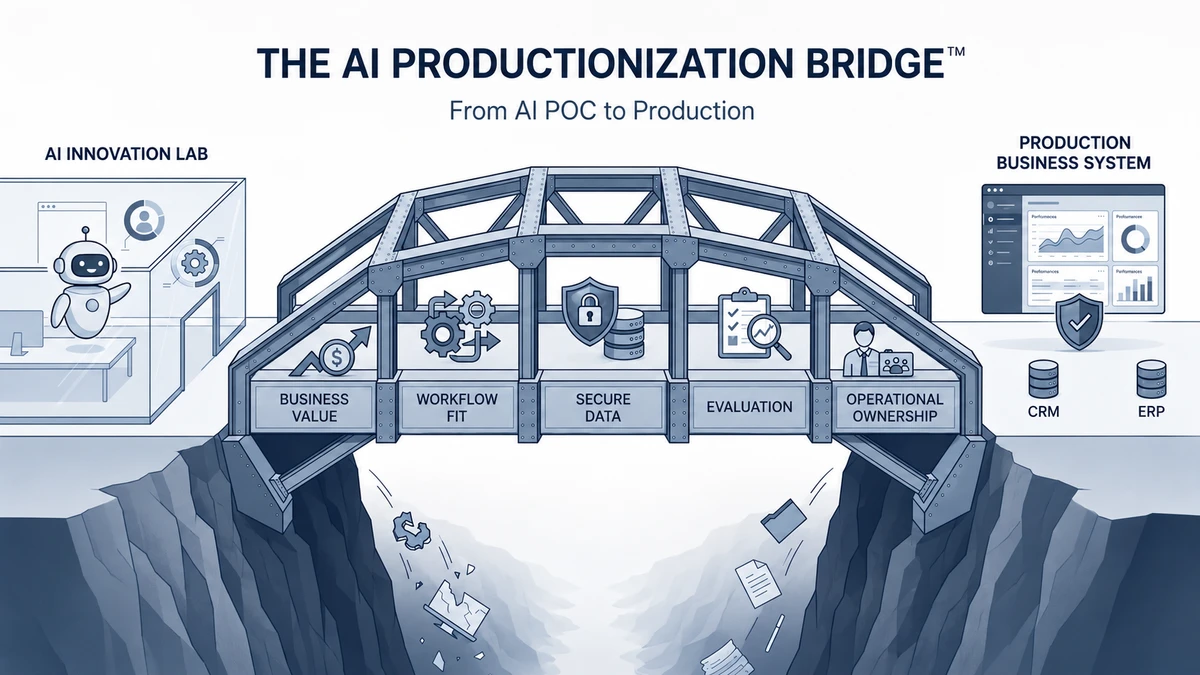
Production readiness is demonstrated through business ownership, workflow fit, reliable and permission-aware data, suitable architecture, enterprise integration, repeatable evaluation, security and governance controls, adoption readiness, and an accountable run model.
Sources
- Gartner, Gartner Predicts 30% of Generative AI Projects Will Be Abandoned After Proof of Concept by End of 2025, press release, 29 July 2024. gartner.com ↩
- Gartner, Why Half of GenAI Projects Fail. gartner.com ↩
- Gartner, Gartner Predicts Over 40% of Agentic AI Projects Will Be Canceled by End of 2027, press release, 25 June 2025. gartner.com ↩
- Microsoft, Work Trend Index 2025: The Year the Frontier Firm Is Born. microsoft.com
- Microsoft Learn, Secure and governed data foundation for Microsoft Copilot — foundational deployment guidance. learn.microsoft.com ↩
- Microsoft Learn, Microsoft Purview data security and compliance protections for Microsoft 365 Copilot and other generative AI apps. learn.microsoft.com ↩
- NIST, AI Risk Management Framework. nist.gov ↩
- ISO/IEC 42001:2023, Artificial intelligence management system. iso.org ↩