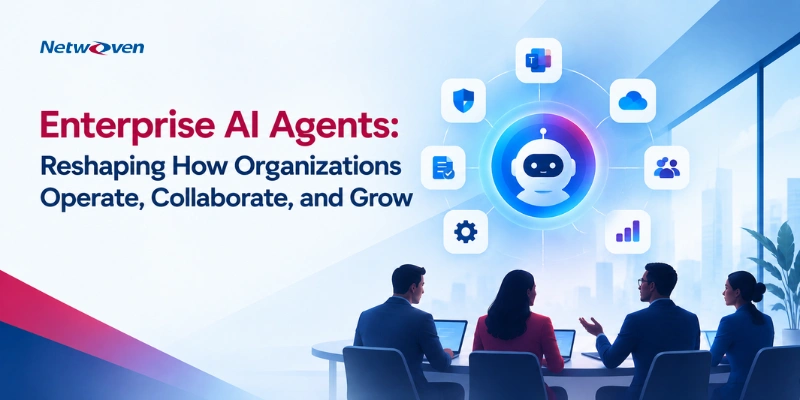
At Microsoft Build 2026, Satya Nadella framed the moment enterprises are living through with a line that’s since become shorthand across the industry. Companies aren’t just adopting AI features anymore, they’re starting to manage AI agents the way they manage a workforce, with identity, permissions, and policy, “just like employees.” Nadella has pointed to Microsoft’s own Agent 365 platform, built on identity tools like Entra and governance tools like Microsoft Purview, as the infrastructure for exactly that shift. Agents are being treated as digital coworkers who need security, observability, and management, not just deployment.
That reframing matters because it describes something real happening inside companies right now. The most interesting adoption stories aren’t top-down IT mandates. They’re bottom-up. Employees find friction in their own work, build an agent to solve it, and momentum spreads through word of mouth faster than any governance team can track. The result is a genuinely new kind of organizational challenge. How do you keep the enthusiasm of employee-led AI adoption while still building the trust and control structures a “digital employee” requires?
Four real cases, from agricultural manufacturing to Microsoft’s own website, show what this looks like in practice, and what it’s doing to how companies actually work.
Example 1. AGCO’s Employee-Led Agent Explosion
Example. AGCO Corporation, the agricultural machinery giant behind brands like Massey Ferguson, Fendt, and Valtra, set out to give employees safe, sanctioned access to AI rather than let them experiment with ungoverned tools on the side. At a leadership meeting of roughly 2,200 people, AGCO simply asked who wanted to start building agents with Microsoft Copilot Studio. About 900 employees raised their hands on the spot. That maker community has since grown to roughly 2,000 people across the company, with several hundred agents now running in production and several hundred more moving through review cohorts.
Reason. AGCO’s leadership made a deliberate choice not to lead with “how can AI help you,” a question Aryn Drawdy, the company’s Director of Strategic Partnerships, called “a mistake.” Instead they asked where the friction actually was. In AGCO’s manufacturing environment, quality and warranty issues routinely stretched over weeks or months because resolving them depended on a small pool of experts coordinating across teams outside any structured workflow. The bet was that citizen-built agents, paired with expert AI governance rather than a central IT mandate, could close that gap faster than any top-down program.
Impact. Some quality reviews that used to take weeks now take about an hour. Todd Bailey, AGCO’s VP and Chief Digital & AI Officer, described the goal as “applying it where it matters most” rather than experimenting with AI for its own sake. Culturally, the shift shows up in small but telling ways, Drawdy says employees now approach her daily asking how to get a Copilot Studio license, not whether they should. But that grassroots energy also forced AGCO to build a genuine governance layer alongside it, a “not shadow IT, it’s support” model where citizen-built agents graduate through cohorts designed to consolidate and harden them into enterprise-grade tools before they touch real manufacturing decisions.
Source: AGCO scales employee-built AI agents with Microsoft Copilot Studio, Microsoft Customer Stories
Example 2. “Ask Microsoft” and the Commercial Case for Agents
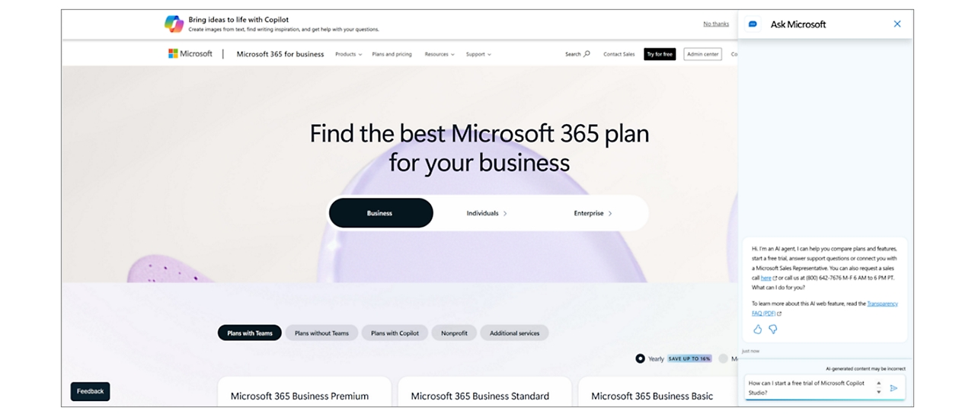
Example. Microsoft’s own website runs on an agent it calls “Ask Microsoft,” built with Copilot Studio to answer visitor questions about products, pricing, and services. The original version was built and shipped in a matter of weeks. As traffic and knowledge sources grew, though, its single-agent architecture began to strain, response times slowed and the experience degraded.
Reason. Rather than scrap the agent, Microsoft’s team rebuilt it using Copilot Studio’s newer multi-agent orchestration capabilities, splitting the monolithic bot into a main orchestrating agent connected to domain-specific sub-agents covering areas like Azure, Microsoft 365, pricing, and trials. Each sub-agent handles its own specialty, and the orchestrator stitches the answers into one coherent, multi-turn conversation.
Impact. The upgraded architecture cut response latency by up to 61% and reduced human escalations by up to 70%. On the Azure site specifically, it drove 16% more trial starts. Most notably from a commercial standpoint, according to Alyse Muttera, Microsoft’s Director of eCommerce Programs, customers who engage with the Ask Microsoft agent are ten times more likely to move forward and sign up for a service. This is a case where the “digital employee” isn’t managing internal workflow, it’s a customer-facing revenue driver, and the architecture decision, many specialized agents instead of one generalist, turned out to be as important as the AI itself.
Source: Microsoft uses Copilot Studio to reshape customer experience and drive higher engagement, Microsoft Customer Stories; SAPinsider coverage
Example 3. The Same System, a Different Lesson. Multi-Agent Support at Scale
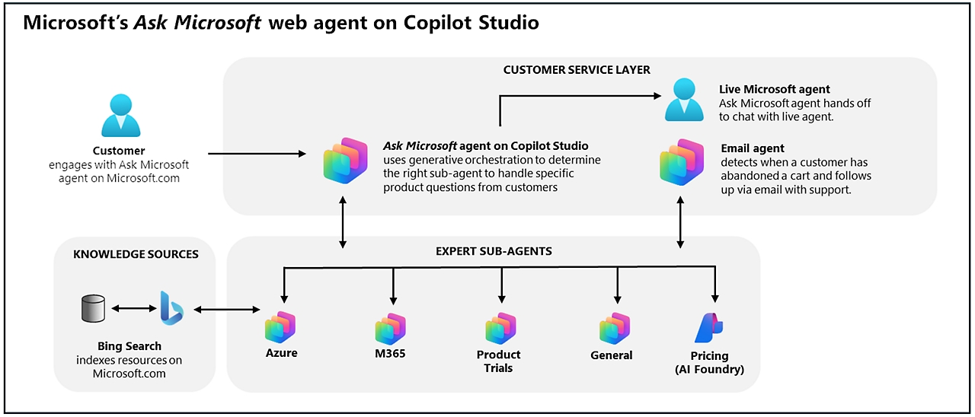
Example. The Ask Microsoft rebuild is also Microsoft’s flagship example of multi-agent orchestration solving a support-scale problem. Instead of one bot trying to know everything, specialized sub-agents own their domains and hand off seamlessly, including live transfer to a human agent when needed, with the option for the customer to return to the AI conversation afterward.
Reason. As the underlying knowledge base grew, including long pricing pages that exceeded what a single Copilot Studio agent could index, a monolithic design became a liability rather than a convenience. Microsoft’s team wanted to preserve fast, accurate answers without forcing customers through a maze of disconnected chat windows, so they connected Copilot Studio agents to Microsoft Foundry agents for handling larger knowledge sources.
Impact. Beyond the latency and escalation numbers above, the case illustrates a structural lesson that’s shaping how enterprises think about agent culture. Complexity doesn’t get solved by making one agent smarter, it gets solved by giving many agents narrower, well-governed jobs and a shared way to coordinate. That’s a direct analog to how human teams scale, specialists supported by a coordinator, and it’s becoming the template other Copilot Studio customers are pointed toward.
Source: Microsoft Copilot Blog
Example 4. Treating an Agent Like a New Hire
Example. One of the Microsoft partners across Australia and New Zealand, built “Agent MIA” (Microsoft Incentive Agent) using Copilot Studio to help its own client-facing teams navigate Microsoft’s partner incentive programs, hundreds of pages of rules that change every fiscal year and directly affect deal funding and financial outcomes for both the company and its clients.
Reason. According to Microsoft Alliance Manager Eisa Quelette, the problem was simply having an easier way to understand the commercial incentives that roll out every fiscal year. The complexity was creating real bottlenecks for teams that needed fast, accurate answers to keep deals moving. The company deliberately framed Agent MIA not as a chatbot feature but as a digital employee, a distinction the company says shaped everything from how it was trained to how its performance is reviewed.
Impact. Agent MIA now answers natural-language questions instantly, checks eligibility, identifies next steps, and surfaces funding opportunities that teams previously might have missed entirely. But the company’s most widely cited takeaway isn’t a metric, it’s a governance lesson. AI adoption is not “set and forget.” Agent MIA’s reliability, the company found, depends entirely on the unified, governed data underneath it, without trustworthy, well-maintained incentive and customer data, the agent couldn’t operate confidently at any scale. The compnay now manages it with the same ongoing feedback and refinement loop it would apply to any new hire, because that’s functionally what the agent is.
The Cultural Shift. From Central Control to Governed Momentum
Put example-1 and example-4 side by side and a pattern emerges that says more about enterprise culture than any latency metric.
Adoption is starting with employees, not IT. In example-1, the company AGCO didn’t roll out agents through a top-down technology mandate, it asked where people were already frustrated, and let hundreds of employees volunteer to build the fix themselves. That inverts the traditional enterprise software rollout, where IT selects a tool and trains the org on it after the fact. Here, the org built momentum first, and governance had to catch up.
Roles are shifting from execution to oversight. At AGCO, small expert teams no longer spend weeks manually reviewing every quality issue, agents read, validate, and advance issues, while experts focus on the judgment calls that still require them. The other company’s frame makes this explicit, the human role becomes managing the agent’s performance, not doing the underlying task the agent now does.
Grassroots enthusiasm creates a governance problem before it creates a solved one. AGCO’s own language is instructive. Drawdy insists their program is “not shadow IT, it’s support,” which is only a meaningful distinction because the alternative, ungoverned, employee-driven AI sprawl, was a live risk. The company built a maker community, training pipelines, and consolidation cohorts specifically because 900 (then 2,000) employees building agents on their own initiative is exactly the kind of momentum that outpaces central control if nobody builds the rails alongside it.
“Human plus agent” is becoming a defined working pattern, not an aspiration. In example-4, the company’s incentive team doesn’t replace their own judgment with Agent MIA, they use it to skip the repetitive lookup work and spend their time on the funding strategy and client relationship decisions that actually require a person. That’s the same shape Nadella describes when he talks about agents needing identities and permissions “like employees,” not autonomous replacements, but teammates with defined scope, operating within responsible AI governance and human oversight alongside the people who supervise them.
As agents become part of everyday work, organizations must also consider where employees will access them, whether through Microsoft Teams, Microsoft 365 Copilot, or an agent-driven modern intranet.
The Honest Caveats
None of this is a story of frictionless success, and the sources above are candid about where the hard parts remain.
Governance is playing catch-up to adoption speed. AGCO’s own account is a case study in this tension. Enthusiasm scaled from 900 to 2,000 makers before the enterprise-grade quality framework was fully built out. The company’s response, cohorts to consolidate and harden citizen-built agents, a cross-functional review structure, close partnership between employees and AI or governance teams, is a reasonable model, but it exists precisely because unmanaged momentum is a real risk, not a hypothetical one.
Reliability depends on data foundations most companies underestimate. In example-4, the company’s explicit lesson is that Agent MIA’s usefulness is entirely downstream of governed, trustworthy data. An agent layered on top of messy, inconsistent, or ungoverned information can produce unreliable answers at scale, making DSPM for AI data security essential for identifying sensitive data, oversharing, misclassification, and uncontrolled reuse.
“Digital employee” status doesn’t mean unsupervised. Nadella’s own framing pairs “digital employees” with identity, containment, and observability. Agent 365’s core pitch is that agents need the same kind of managed access and accountability structures as human employees, not less. Human-in-the-loop oversight isn’t a transitional phase to be engineered away, it’s the design principle that makes scaling agents safe in the first place.
Metrics like AGCO’s “weeks to an hour” or Ask Microsoft’s 10x conversion lift are compelling, but they’re outcomes of specific, well-scoped use cases, quality review triage, customer web support, not a guarantee that any agent deployed anywhere produces similar gains. The common thread across every case here is a narrow, well-defined friction point paired with governed data and a clear owner, not AI applied indiscriminately.
Conclusion. The Win Isn’t the Agent Count
Nadella’s “bicycle for the mind” framing was originally about individual cognition, AI as an amplifier of what one person can do, not a replacement for them. The enterprise version of that idea is playing out at the companies in the above examples, and inside Microsoft’s own web infrastructure. The agents that matter aren’t the ones deployed for their own sake, they’re the ones aimed precisely at a friction point, given governed data to work with, and paired with people who stay accountable for the outcome.
This human-agent working model is also influencing the evolution of AI-driven intranets and future work platforms, where people and agents collaborate within the everyday flow of work.
The companies quoted here aren’t competing on how many agents they’ve shipped. AGCO’s leadership is explicit that the goal was never “a million unconnected agents,” it’s a governed framework where employee-driven momentum and enterprise control reinforce each other instead of fighting. That, more than any single latency or conversion number, is the real cultural shift agents are forcing. Enterprises are learning to build the trust and governance loop around their digital workforce with the same seriousness they’ve always applied to their human one.
If you have any other questions, please contact our experts.
Sources
1. Microsoft Cuts Web Agent Latency, Human Escalations – SAPinsider
2. What’s new in Copilot Studio: Updates to multi-agent systems – Microsoft Copilot Blog
3. Strong data foundations critical for agentic AI success – CIO.com
4. Microsoft Build 2026 Day 1: Satya’s Keynote, Agentic AI, and the Race to Ship – Multishoring