Most SharePoint intranets are ghost towns, and everyone knows it
We’ve done enough intranet projects to know the pattern. The launch goes well, adoption looks good for six weeks, then the engagement numbers flatline. Employees visit the intranet when they absolutely have to — expense reports, policy documents, mandatory HR stuff — and not much else.
Static pages are a big part of why. If every visit shows the same layout it showed last month, there’s no reason to come back. The intranet becomes a digital filing cabinet rather than a place where work actually happens.
Microsoft Viva Connections changes that calculus, especially when you build the dashboard using Adaptive Cards. This isn’t a small UX refresh – it’s a different model for how the intranet interacts with employees.
In this blog post, we will delve into the role of Adaptive Cards in SharePoint Intranet modernization and explore how they can revolutionize internal communications with some use cases. As we wrap up this blog, we’ll take a look at some fascinating facts about designing Adaptive Cards.
What Adaptive Cards actually are
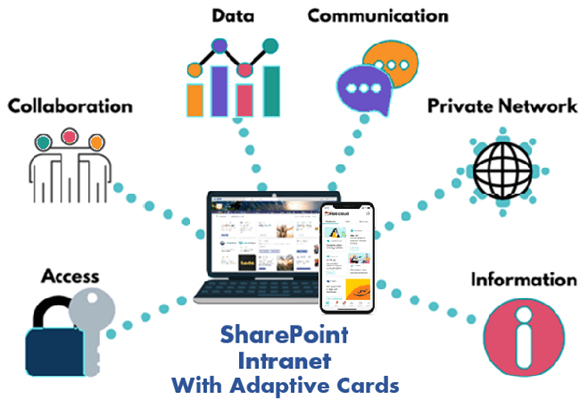
Adaptive Cards are lightweight, interactive content blocks built in JSON. Microsoft developed them to render natively across Teams, Outlook, and SharePoint/Viva Connections – the card adapts its layout to whatever surface it’s displayed on, and on whatever screen size. A card you build once works on the Teams mobile app, the Viva Connections dashboard on a laptop, and an Outlook Actionable Message.
The big difference from a traditional web part: Adaptive Cards can pull live data from APIs, SharePoint lists, or external systems, present that data dynamically, and accept user input through forms and buttons – all without the user navigating anywhere. The interaction happens inline.
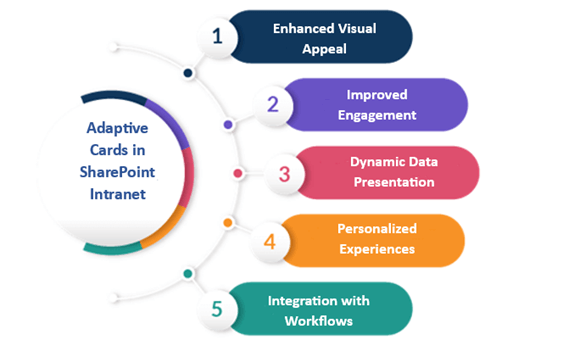
Adaptive Cards vs. traditional SharePoint web parts
| Capability | Adaptive Cards (Viva) | Traditional Web Parts | Practical Difference |
| Mobile experience | Native app-like rendering in Teams mobile | Responsive but not native | Cards feel like apps on mobile. Web parts feel like websites. |
| Real-time data | Live API or SharePoint list data | Possible but requires custom dev | Cards make dynamic data the default, not the exception |
| User interaction | Forms, buttons, inputs – all in the card | Minimal without custom development | Users can submit forms, log tickets, mark tasks done – inline |
| Personalization | Role-based, location-based, preference-based | Audience targeting only | Cards can show different content to different people automatically |
| Build complexity | JSON authoring; SPFx for dynamic cards | No-code options available | Lower floor for simple cards; higher ceiling with SPFx |
| Teams integration | Native – same card in Teams and SharePoint | SharePoint only | One build, two surfaces. Web parts don’t cross over. |
| Workflow triggers | Direct form submit from within the card | Typically needs a Power Automate trigger | Cards collapse the gap between seeing a task and acting on it |
Ten use cases that have actually worked in client deployments
These aren’t hypothetical. They’re from real Viva Connections projects we’ve delivered or seen in production.
Some examples of Adaptive Card Use Cases in SharePoint Intranet:
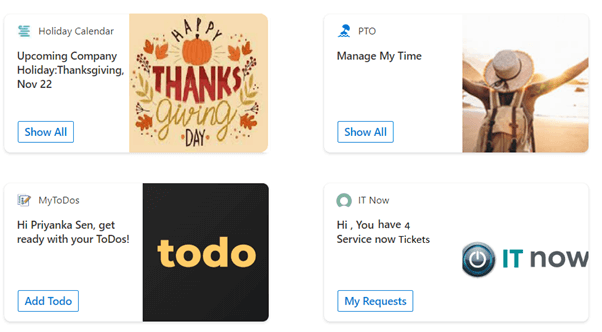
1. ServiceNow ticket integration
Connect the Viva dashboard to ServiceNow’s API and display a user’s open IT incidents right there. Employees check ticket status without leaving the intranet, and IT deflects a significant chunk of ‘any update on my request?’ emails.
2. Holiday calendar
A card that pulls from a SharePoint list of holidays for the user’s region. Always accurate, no manual updates, no ‘someone forgot to update the intranet’ situations three days before a long weekend.
3. Leave and PTO tracking
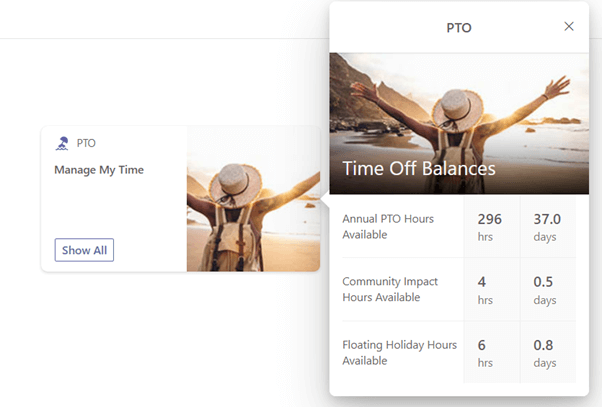
Show employees their current leave balance and recent requests in the dashboard card, with a Quick View panel for the full history. Reduces the volume of ‘how many days do I have left’ questions HR fields every January.
Sample Employee PTO and Leave Tracking Adaptive card with a Quickview showing details:
4. Annual goal tracking
An interactive card with a simple form where employees can log and update their goals for the year. Surfaces in their dashboard every time they visit. Less friction than opening a separate app.
5. Personal to-do list
A lightweight task card backed by a SharePoint list. Not trying to replace Planner or Tasks, but useful for simple personal task capture from the intranet home page.
6. Birthdays and work anniversaries
Cards with photos, names, and milestone dates for teammates. Small thing, but it reliably comes up in adoption surveys as something employees appreciate — especially in hybrid teams where you don’t see people daily.
7. Announcements with read receipts
Replace plain text announcement banners with cards that include images, a brief description, and a button employees click to acknowledge. You get visibility into who’s read the communication. Compliance teams love this for mandatory policy updates.
8. Inline surveys and polls
Surface a two-question pulse survey directly in the dashboard. Response rates are meaningfully higher than a link that takes employees to a separate form — reducing the number of steps increases completion.
9. Workflow task cards
Show pending approvals or workflow tasks in the card. Employees can approve, reject, or update status directly from the card without opening Power Automate or a separate app.
10. Event invitations with RSVP
Event cards that include date, description, a one-click RSVP, and an Add to Calendar action. Works especially well for town halls, training sessions, and company events where attendance matters.
Frequently Asked Questions
Adaptive Cards are JSON-based interactive UI blocks that Microsoft built to work across its platforms – Teams, Outlook, and the Viva Connections dashboard on SharePoint. They’re different from static web parts because they can show live data, accept input through embedded forms and buttons, and render natively in the Teams mobile app. The ‘adaptive’ part means the card adjusts its layout automatically based on the platform and screen size it’s displayed on.
Web parts are the traditional building blocks for SharePoint pages – they’re good at layout, content display, and aggregating Microsoft 365 content. Adaptive Cards, used in the Viva Connections dashboard, are built for interaction. A web part can show a news feed; an Adaptive Card can show your open support tickets and let you update their priority without navigating away. The other key difference: a card you build for Viva Connections also renders natively in the Teams mobile app. Web parts stay in SharePoint.
For simple, static cards – a company announcement with an image and a button, a holiday calendar pulling from a SharePoint list – no. Microsoft’s built-in Card Designer in SharePoint and the free Adaptive Card Designer at adaptivecards.io let you build these without writing code. For dynamic cards that pull live data from APIs or external systems, you’ll need a developer who can build SPFx Adaptive Card Extensions. The complexity scales with what you’re trying to do.
Yes, and this is genuinely one of their strongest selling points. Because they render natively in the Teams mobile app, employees get an app-like experience on their phones rather than a responsive-web approximation. If you have a significant portion of employees who primarily access the intranet on mobile – field staff, manufacturing floor workers, retail employees – Adaptive Cards are worth the investment for the mobile experience alone.
Viva Connections is the Microsoft 365 product that provides the employee experience dashboard – the surface where Adaptive Cards live. It’s included with Microsoft 365 E3/E5 and Microsoft 365 Business Premium, so if you’re already on those plans, you have access. You don’t need a separate Viva Connections license to get the dashboard functionality. Some of the broader Viva suite (Viva Insights, Viva Learning, etc.) does have additional licensing, but Connections itself comes with your existing M365 subscription.
Two paths depending on what you need. For simple, read-only display of SharePoint list data, the built-in Card Designer can handle basic configurations. For anything more complex – filtering by the current user, writing data back to the list, displaying data with custom logic – you’ll build an SPFx Adaptive Card Extension that calls the SharePoint REST API or Microsoft Graph. Microsoft’s SPFx documentation covers this, and the PnP community has published starter templates that cut the setup time significantly.
A few things to know before you start building
The Adaptive Card Designer at adaptivecards.io is genuinely good and free. Start there before writing any JSON by hand. Microsoft also maintains a library of sample templates at adaptivecards.io/samples that cover most common patterns.
For cards that need to pull real-time data from SharePoint lists or external APIs, you’ll need SPFx Adaptive Card Extensions (ACEs). That’s developer territory, but the SPFx documentation is reasonably thorough and the community has published a lot of starter templates.
SharePoint’s built-in Card Designer handles simple, static cards with no code required. Good for getting something on the dashboard quickly, less good for anything dynamic.
The question we get most often at project kickoff: ‘How many cards should we launch with?’ Answer: three to five, max. Build them well, measure engagement, then add more. A dashboard with fifteen mediocre cards is worse than one with four excellent ones.