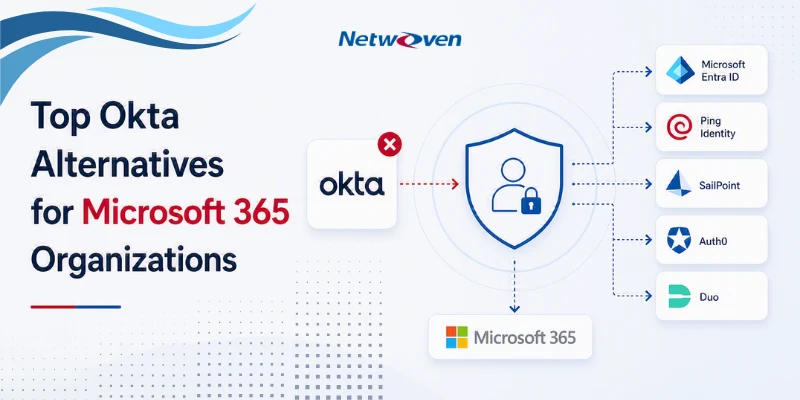
A data-backed evaluation of where Okta fits, where it doesn’t, and how Microsoft-centric organizations should choose an identity platform in 2026 – with an honest comparison matrix.
Introduction
If your organization runs Microsoft 365, the honest version of “what are the alternatives to Okta?” is a narrower question than it looks. You are not choosing an identity provider from a blank slate. You almost certainly already own one. The real decision is whether to keep paying a second vendor for capabilities that increasingly overlap with what you’re already licensed for – and whether the platform you already own is good enough to consolidate onto.
Most Okta alternatives listicles skip that part. They’re written to sell a switch.
This one isn’t.
This guide answers that with data rather than assertion. We look at where the identity market actually sits in 2026, lay out a repeatable framework for scoring any alternative against a Microsoft-centric estate, profile the credible contenders fairly – including the cases where Okta or another vendor is genuinely the better choice – and then make a reasoned recommendation. Netwoven runs Okta to Entra migrations for a living, so we have a point of view; we’ve tried to earn it here rather than assume it.
The state of the identity market in 2026
Three facts frame the entire decision, and all three have shifted in the last two years.
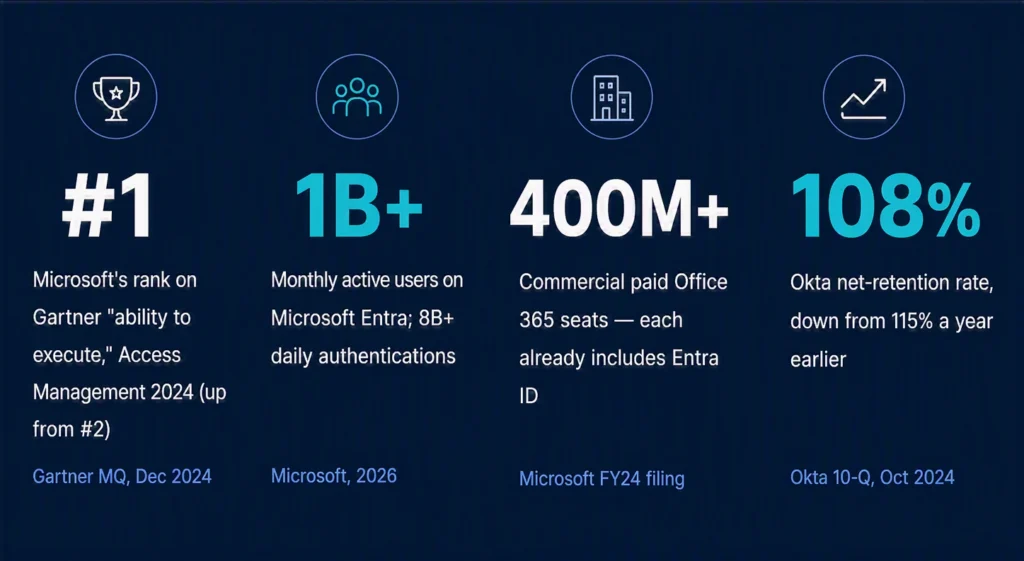
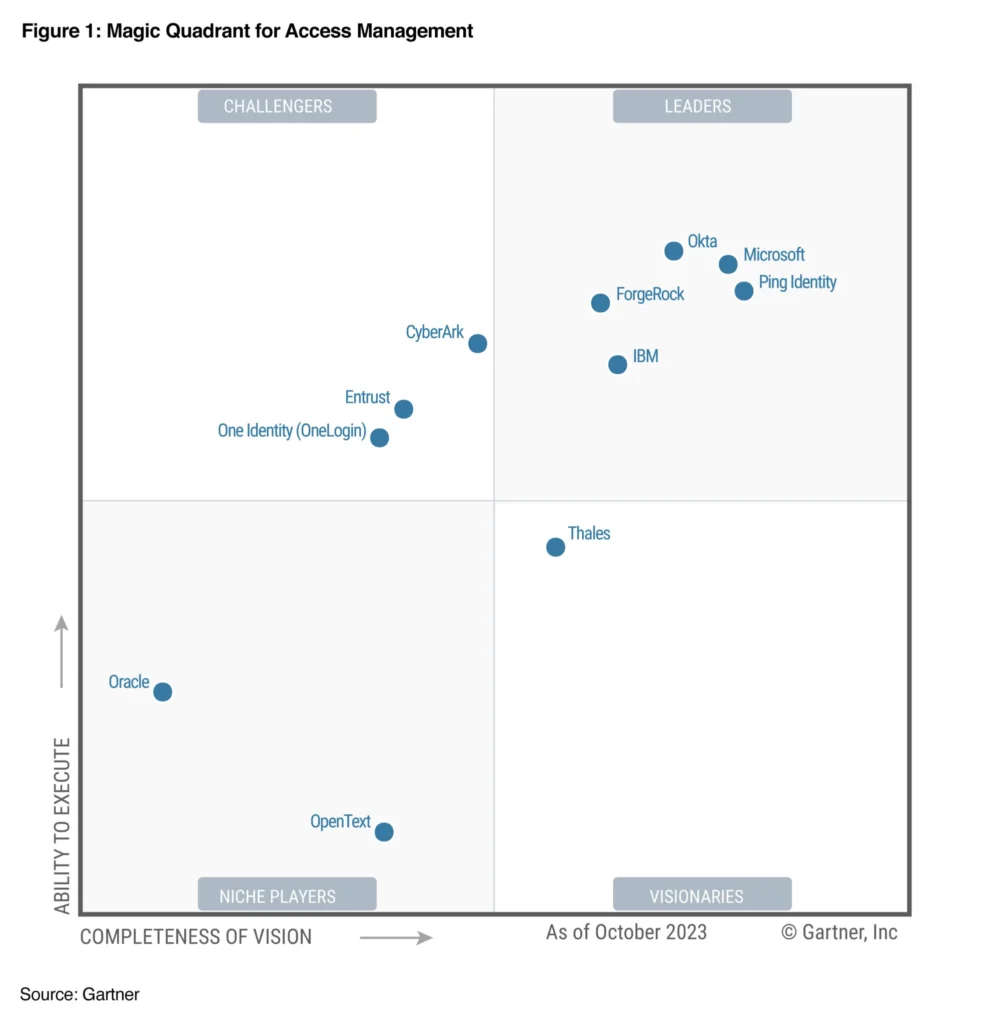
First, the market leadership has changed hands. In Gartner’s Magic Quadrant for Access Management, the leaders’ group – Microsoft, Okta, Ping Identity, and IBM — has stayed stable, but the order has not. On ability to execute, Microsoft moved to first place in the 2024 evaluation, with Okta second and Ping third; a year earlier, Okta held the top execution spot. Okta remains a Leader (its ninth consecutive year in the 2025 report), so this is a story of a tightening race, not a collapse — but the momentum has clearly moved toward Microsoft.
Second, the scale gap is enormous. Microsoft Entra now serves more than 800,000 organizations and over one billion monthly active users, processing over eight billion authentications a day. Okta, by contrast, reported 19,450 customers in its October 2024 filing. Both are large, credible platforms but they operate at different orders of magnitude, and that scale is what funds Microsoft’s security-signal advantage.
Third, the overlap is already paid for. Microsoft has surpassed 400 million commercial paid Office 365 seats. Every one of those seats includes Entra ID at some tier. For a Microsoft-centric organization, that changes the alternatives question from “which product should we buy?” to “should we keep buying a product we already have?”
Gartner Access Management leadership shifted between 2023 and 2024
Leaders’ ranking by ability to execute. Positions shown are leaderboard order, not Gartner’s underlying scores. Source: Gartner Magic Quadrant coverage.
2023 — ability to execute
- Okta
- Microsoft
- Ping Identity
- ForgeRock
- CyberArk
2024 — ability to execute
- Microsoft ▲ from #2
- Okta ▼ from #1
- Ping Identity — held
- CyberArk ▲
- Entrust
Why Microsoft 365 organizations start looking for alternatives
Organizations rarely go shopping for an Okta replacement because the product stopped working. In our engagements, the trigger is almost always one of four business realities:
- Duplicate licensing. Finance notices the company is paying Okta per user while already entitled to Entra ID inside its E3 or E5 agreement. The renewal conversation becomes “why are we paying twice?”
- Consolidation pressure. Security teams are under pressure to run fewer tools, not more. A second identity platform means a second policy engine, a second admin surface, and a second integration to keep in sync with everything else.
- Zero Trust maturity. Leadership wants device-aware, risk-based access — which is materially easier when identity, device compliance (Intune), and threat signals (Defender, Sentinel) live in one ecosystem.
- A contract or security event. An upcoming renewal, an acquisition that fragmented the identity estate, or a security incident forces a re-evaluation that had been deferred for years.
None of these is a criticism of Okta as technology. They’re structural pressures that apply specifically to organizations whose center of gravity is already Microsoft. If yours isn’t, several points below will push you the other way – and we say so explicitly.
Here’s how it actually surfaces. Finance runs a license true-up before renewal, sees a six-figure Okta line, and asks the CISO one question: what does this buy us that E5 doesn’t? The CISO rarely has a clean answer because for workforce SSO, the honest answer is “not much.”
That meeting is where most migrations start. Not in a strategy offsite.
A framework: the M365 Identity Fit Score
Best Okta alternative is the wrong question because it has no context. The right question is “best fit for our estate.” To make that repeatable, score every candidate from 1 to 5 across six dimensions weighted for a Microsoft-centric organization. This is the framework we use in discovery, and you can apply it yourself.
Native M365 & Azure depth
How deeply does it integrate with Entra tenants, Intune device state, Defender, Sentinel, and Purview — natively, not via connectors?
Licensing overlap & TCO
How much of its capability do you already own inside M365? Net new spend vs. capability you’d be double-paying for.
Security signal & Zero Trust
Strength of risk-based Conditional Access, identity protection, and the threat-intelligence scale behind the risk engine.
App integration breadth
Coverage of your app estate — including the non-Microsoft, legacy, and multi-cloud apps where a neutral vendor can win.
Governance & lifecycle
Access reviews, entitlement management, privileged access (PIM), and joiner-mover-leaver automation.
Operational consolidation
Does adopting it reduce the number of vendors, policy engines, and admin surfaces — or add one?
Weighting matters. For a Microsoft-365-centric org, factors 1, 2, and 6 typically carry the most weight, because that’s where consolidation value concentrates. For a heterogeneous or multi-cloud estate, factor 4 dominates – and that reweighting is exactly what can flip the answer away from Microsoft.
If you want the answer before you build the scorecard, ask five questions. They tell you most of it.
- What percentage of your federated apps are Microsoft or Microsoft-adjacent? Above 70%, the matrix has probably already decided.
- Are you on E5, or E3 with add-ons? This sets what “already paid for” actually covers – and it’s where the CFO’s business case lives or dies.
- Who owns your Conditional Access equivalent today, and can they explain every policy? If not, you have hidden risk regardless of which vendor you land on.
- Would concentrating identity, device, and security telemetry in one vendor violate a board-level risk position? For some regulated firms it does. Respect that early.
- Is anyone still running on-prem AD in the mix? That answer reshapes the whole sync and federation plan.
The credible alternatives, profiled honestly
Here are the platforms that legitimately belong in an Okta-replacement evaluation, each with the scenario where it genuinely wins. We’ve included the honest “worse fit when…” for every one, including our recommended pick.
Microsoft Entra ID Usually the best fit for M365
The identity platform already inside your Microsoft 365 tenant. Delivers SSO, MFA, Conditional Access, Identity Protection, lifecycle governance, and PIM from the same tenant as your mail, files, and Teams data.
Wins when: your estate is Microsoft-centric, you hold E3/E5, and you want one control plane spanning identity, device, and threat signals. Consolidation and TCO are the decisive factors.
Weaker when: you need deep vendor-neutral CIAM at scale, highly heterogeneous multi-cloud coverage, or advanced customer-identity orchestration — areas where specialists still lead.
Ping Identity (incl. ForgeRock) Enterprise / heterogeneous
A Gartner Leader with strong enterprise, hybrid, and CIAM capabilities, strengthened by the ForgeRock acquisition and DaVinci orchestration. Standards-based and deliberately vendor-neutral.
Wins when: you run a complex, multi-cloud, or heavily customized environment and value orchestration and neutrality over ecosystem lock-in.
Weaker when: you’re a lean Microsoft shop — the portfolio can be complex to deploy, and much of what you’d buy overlaps with Entra you already own.
One Identity (OneLogin) Mid-market SSO
A Gartner Challenger offering solid SSO and access management, often at a friendlier price point for mid-market organizations.
Wins when: you want straightforward workforce SSO without the Microsoft ecosystem tie-in and Ping’s complexity.
Weaker when: you need the depth of governance, PIM, and native device/threat integration that the ecosystem players provide.
JumpCloud SMB / cross-OS
A cloud directory that unifies identity and device management across Windows, macOS, and Linux — popular with smaller, mixed-OS organizations.
Wins when: you’re an SMB with a heterogeneous device fleet and no heavy Microsoft 365 investment to consolidate onto.
Weaker when: you’re an enterprise with M365 E5, advanced Conditional Access needs, or strict governance requirements.
Google Cloud Identity Google-leaning estates
Google’s identity layer, strongest for organizations already standardized on Google Workspace and Google Cloud.
Wins when: your productivity and cloud estate is Google, not Microsoft.
Weaker when: you run Microsoft 365 — you’d be trading one ecosystem tie-in for another, without the licensing overlap benefit.
Cisco Duo & Auth0 Layer, not full replacement
Two common “alternatives” that are really complements. Duo is an MFA/secure-access layer that sits on top of an IdP; Auth0 (now owned by Okta) is a developer-focused CIAM platform for customer identity, not workforce SSO. Microsoft’s equivalent for external identity is Entra External ID.
Wins when: the specific job is strong MFA (Duo) or embedding customer login into an app you’re building (Auth0 / Entra External ID).
Weaker when: you expected them to replace your workforce identity provider outright — they’re not designed for that.
The comparison matrix
Scores below are for a Microsoft-365-centric organization, on the six-factor framework above (1 = weak, 5 = strong). The same vendors would score differently for a Google-centric or heavily heterogeneous estate — the context is the whole point.
| Factor (weighted for M365) | Entra ID | Ping | One Identity | JumpCloud | |
|---|---|---|---|---|---|
| Native M365 & Azure depth | 5 | 3 | 2 | 2 | 2 |
| Licensing overlap / TCO | 5 | 2 | 3 | 3 | 2 |
| Security signal & Zero Trust | 5 | 4 | 3 | 3 | 3 |
| App integration breadth | 4 | 5 | 3 | 3 | 3 |
| Governance & lifecycle (IGA/PIM) | 5 | 4 | 3 | 2 | 3 |
| Operational consolidation | 5 | 2 | 3 | 3 | 2 |
These scores are Netwoven’s assessment for a Microsoft-centric context, not vendor benchmarks. Notice the one row Entra doesn’t top: app-integration breadth, where Okta’s and Ping’s neutral, third-party-heavy networks are a real strength. That single row is where most legitimate “keep Okta” arguments live.
Why Entra ID usually wins – for Microsoft 365 organizations
For the specific population this guide addresses, the matrix concentrates value in three places, and each is backed by something concrete rather than a slogan. Three reasons. All unglamorous. All decisive.
You already own it. With Entra ID bundled into 400 million-plus Office 365 seats, consolidation removes a standalone per-user subscription rather than adding one. The financial case writes itself before you evaluate a single feature.
The security signal is a genuine moat. Microsoft’s risk engine is trained on the telemetry of a platform processing billions of daily authentications and tens of trillions of security signals – scale that a smaller vendor structurally cannot match. For risk-based Conditional Access, that scale translates into better detections.
Consolidation compounds. When identity (Entra), device compliance (Intune), endpoint (Defender), and SIEM (Sentinel) share one tenant, Zero Trust stops being an integration project and becomes a configuration one. Fewer seams, fewer vendors, fewer places for policy drift to hide.
This is also the conclusion of our own field work: across engagements, teams that consolidated onto Entra ID reduced duplicate licensing and simplified their policy surface, provided the migration preserved MFA and Conditional Access parity. That proviso is not a footnote; it’s the whole risk, and it’s covered in depth in our MFA and Conditional Access parity guide.

When it’s not Entra ID – the honest cases
A guide that recommended Microsoft in every scenario wouldn’t be worth linking to. Here’s when we tell organizations to keep Okta or choose someone else:
- Highly heterogeneous or multi-cloud estates. If most of your applications live outside the Microsoft world and vendor-neutral breadth matters more than ecosystem depth, Okta or Ping’s integration networks are a real advantage.
- Advanced customer identity (CIAM) at scale. For sophisticated consumer-facing identity with heavy customization, specialists like Ping, ForgeRock, or Auth0 still lead. Entra External ID is maturing but is not always the deepest option.
- Deliberate vendor neutrality. Some organizations make a strategic choice not to concentrate identity, security, and productivity in a single vendor. That’s a legitimate risk posture, and independence is exactly what Okta sells.
- Complex privileged access (PAM). Neither Okta nor Entra is a full PAM solution; heavy PAM needs point toward CyberArk or BeyondTrust regardless of your IdP choice.
If two or more of these describe you, run the framework with factor 4 weighted heavily and let the score decide. The answer may well not be Microsoft and that’s the right outcome.
The factor most comparisons skip: security track record
Feature matrices rarely account for a vendor’s own security history, but for an identity platform – the keys to everything else – it belongs in the evaluation. It cuts in more than one direction, so treat it carefully.
In late 2023, Okta disclosed that a threat actor accessed its customer support case-management system. The intrusion began around September 28 and was contained by mid-October. Okta initially reported that files belonging to 134 customers (under 1%) were accessed, then later confirmed the actor had downloaded a report containing the names and email addresses of all Okta customer-support users across its Workforce and Customer Identity products, excluding federal customers. Some support files were HAR files containing session tokens, and five customers had sessions hijacked as a result. The root cause traced to a service account and an employee’s compromised personal Google profile.
Read this fairly. The breach hit Okta’s support system, not its production identity service, and Okta published a detailed root-cause analysis and remediation. Every major vendor – Microsoft included – has had significant security incidents; a single event is not a verdict. The point for an evaluator is not “Okta is unsafe,” but that concentration of trust in any identity vendor is a real risk to weigh, and vendor security posture and transparency deserve a line in your scorecard.
The constructive takeaway is architectural: whichever platform you choose, the controls that would have blunted this incident – tightly governed service accounts, phishing-resistant MFA, short session lifetimes, and strict device trust – are the same controls a well-run Entra or Okta deployment should enforce. Consolidation can reduce the number of trust boundaries, but it never removes the need to operate them well.
If you decide Entra ID is the answer
Choosing the platform is the easy part. Moving to it without a security regression or a user-facing outage is the hard part, and it’s where most of the risk in this entire decision actually lives. A migration touches applications (SAML, OIDC, OAuth), federation, directory synchronization, and – the hardest track – translating Okta sign-on policies into Entra Conditional Access, which Microsoft itself documents as a distinct workstream rather than an automatic conversion.
A word on the traps, because the workstream diagram always looks tidier than the project.
- MFA re-enrollment is a helpdesk event, not a technical one. Every user re-registers their factors. Budget for the ticket spike or the service desk finds out the hard way, on go-live morning.
- Your cleanest pilot will lie to you. Pilots run on cooperative users and well-documented apps. The mess lives in the other 80%.
- That legacy SAML app? The engineer who configured it left in 2022, and nobody has the signing certificate. Discovery finds this. Optimism doesn’t.
- “We’ll just replicate the Okta policies” is where three weeks of Conditional Access redesign quietly hides. It is never a copy-paste.
- Orphaned SCIM rules and nested groups grant access no one remembers approving. You inherit that debt on day one unless you map it first.
None of these are reasons not to migrate. They’re reasons not to migrate blind.
We’ve written the practical detail up across the cluster this guide belongs to:
- Okta to Entra ID Migration – the full service overview and methodology.
- Okta vs Entra ID – the deeper feature-by-feature comparison.
- Mastering the real-world challenges – the internal-readiness gaps that stall projects.
- Cut identity costs without cutting security – the CIO/CFO business case.
- 5 signs it’s time to consolidate – the readiness signals.
Not sure which way the framework points for your estate?
A discovery session maps your Okta environment and scores it against the six factors above — so you get an evidence-based recommendation before you commit to anything, even if that recommendation is to stay put.
Frequently Asked Questions
For workforce identity in a Microsoft-centric organization, yes – Entra ID covers SSO, MFA, Conditional Access, identity protection, and governance. The gap narrows to specific areas like advanced CIAM and vendor-neutral multi-cloud breadth, where specialists can still lead
Almost certainly. Entra ID is included at some tier in Microsoft 365 E3 and E5. Advanced features such as risk-based Conditional Access and Identity Protection require higher tiers, but the core identity platform is bundled – which is why the cost case against a separate Okta subscription is so strong.
When your app estate is highly heterogeneous or multi-cloud, when you need deep vendor-neutral CIAM, or when you deliberately want to avoid concentrating identity in your productivity vendor. In those cases Okta’s neutrality and integration breadth are genuine advantages.
The biggest is security regression – losing MFA or Conditional Access fidelity during cutover. Others include re-registering MFA factors (they don’t transfer between providers) and reconfiguring every federated app. All are manageable with discovery-first planning and a verified parity checkpoint before cutover.
It depends on the number of federated applications and Conditional Access complexity, not headcount. A focused estate can move in weeks; a large estate with many custom integrations takes longer. Discovery produces the realistic timeline.
Sources
- Gartner Magic Quadrant for Access Management 2024 – leadership and market size, via BankInfoSecurity (Jan 2025) and SDxCentral.
- Okta, Inc. Form 10-Q, quarter ended October 31, 2024 (SEC EDGAR) – 19,450 customers; net-retention 108% vs 115%.
- Microsoft Entra scale (800,000+ organizations, 1B+ MAU, 8B+ daily authentications) – Microsoft, cited via GlobeNewswire, 2026.
- Microsoft Corp. FY2024 proxy statement (SEC) – 400M+ commercial paid Office 365 seats.
- Okta customer support system breach – Okta Security root-cause report (Nov 2023); The Record, CSO Online, TechTarget, BeyondTrust (2023).
- Gartner MQ Leader recognitions – Okta and Ping Identity newsrooms (2025).