Introduction
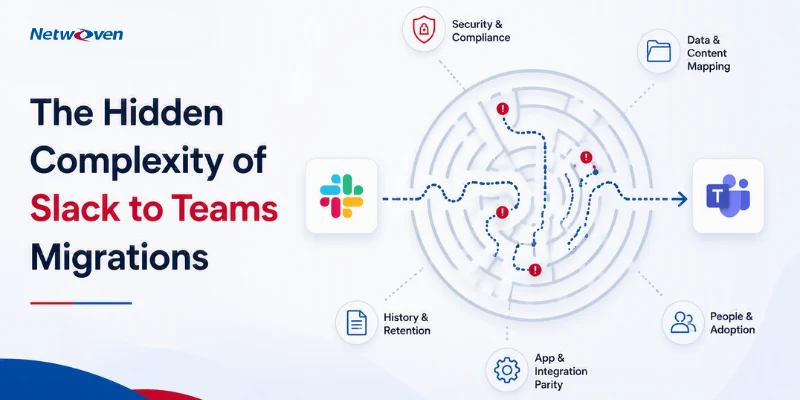
A Slack to Microsoft Teams Migration is rarely only a content move. It’s about more than just data. Slack is deeply embedded in your business units and business processes. Slack environments often include critical & sensitive information, workflows, integrations, bots, and team owned automations. Any migration of Slack needs to ensure the preservation of business process, business continuity and proper handling of sensitive information & permissions.
Let us consider few key challenges that most vendors do not address adequately.
- Slack Workflows, Bots and Custom Apps / Integrations
- Membership and Identity
- Adoption and Change Management
Slack Workflows, Bots and Custom Apps / Integrations
Netwoven has demonstrable experience in moving WF’s and customizations from Slack to M365 and Power Platform. To fully transition from Slack to Teams:
- All needed workflows and custom apps / integrations must be migrated during the project window
- IT typically doesn’t own or manage Slack Workflows or custom apps / integrations. These are usually owned by Slack Channel Owners. To maintain this sense of ownership, we typically provide advisory support (as opposed to migration / re-platforming factory – which we can provide, if your team is short-handed), office hours sessions, code samples and other assistance to accelerate and reduce the time and friction in the transition, by supporting the users in your organization that have built business processes into Slack.
- Foundational Power Platform Center of Excellence
A baseline COE is essential, prior to the migration of your Slack WFs and custom apps / integrations to M365, to ensure that you have a maintainable platform. It includes:
- Environment design (Prod + Sandbox minimum)
- Basic governance & DLP policies
- Solution structuring for migrated apps/flows
- Maker access guardrails
- Monitoring/telemetry setup (COE Starter Kit components)
- (Application Lifecycle Management) ALM-light to ensure stability during migration
- A separate Workstream for WF Migration – Run a dedicated Workflow + App/Integration workstream in parallel with content migration. This must be explicitly structured as a separate workstream focused on assessing and executing the replacement of required workflows and custom apps/integrations, not treated as “post-migration cleanup.”
The slower and less capable tools available in the market would lose authorship information and other key metadata / data. We assist with highly accurate & complete content migrations and accelerated re-platforming for continuity with speed.
Membership and Identity
Slack and Teams use fundamentally different role models. Slack Owners, Admins, Members, and Guests do not map directly to Microsoft 365 or Teams roles. Automated role migration often results in:
- Loss of ownership for critical teams
- Over‑permissioned administrators
- Broken governance and escalation paths
Slack supports fine‑grained, channel‑specific membership. Teams primarily grants access at the Team level. When Slack structures are recreated directly:
- Users gain visibility into conversations they were never part of
- Sensitive discussions become broadly accessible
- User trust drops immediately
Direct and group messages move into Teams chat and require every participant to exist in the target identity system. Incomplete identity mapping leads to broken conversations and lost context.
Slack’s external collaboration model is simple. Teams support multiple models, external access, guest access, and shared channels. Migrating guests without redesign often expands access unintentionally.
Archived Slack channels frequently include former employees and sensitive discussions. Automatically restoring historical membership can re‑expose restricted information.
Organizations that execute successful Slack to Teams migrations treat identity as a design discipline, not a technical task:
- They separate identity migration from role assignment
- They validate access before enforcing compliance policies
- They redesign external collaboration intentionally
- They test access scenarios, not just data completeness
Netwoven transforms Slack’s flexible, channel-level access model into a secure, scalable Microsoft Teams permission framework, aligned with Public/Private Teams and Standard, Private, and Shared Channels.
Netwoven Approach focusses on
- Structured Access Model Design
Netwoven redesigns access by mapping Slack memberships into the appropriate Teams constructs:
- Public and Private Teams for broad vs-controlled access
- Standard Channels for team-wide collaboration
- Private Channels for restricted, sensitive discussions
- Shared Channels for seamless cross-team and external collaboration
- Comprehensive Membership Mapping
Every user, guest, and membership exception is identified and precisely mapped to ensure access in Teams reflects real business needs.
- External Collaboration Alignment
Guest access and external users are aligned with Shared Channel and B2B collaboration models, ensuring secure and governed interaction.
- Pre-Migration Validation
All permission structures are validated before migration begins, eliminating access gaps, security risks, and post-migration rework.
Adoption and Change Management
With 20+ years of migration experience, Netwoven confidently understands that Slack migrations face the most fierce and vocal pushback from the userbase of any type of migration. Slack isn’t remotely bad at what it does. It’s concept of threaded media-based collaboration was such a good idea, that it inspired a new ecosystem of said tools and drove Microsoft to build Teams in response. Slack is so good that it has likely woven itself into the core fabric of your business. Now that the Teams and Slack have largely reached feature parity, you absolutely must address and alleviate these concerns and assist your user base to make the move with minimal disruption to business continuity and productivity to truly achieve the potential ROI.
We strongly believe that Adoption & Change Management (ACM) is one of the most important factors in driving the successful adoption of a new platform, and we work hand in hand with our customers from the very beginning to make sure this happens. This workstream provides the following:
- Complete sample communication plan and copy to accelerate your internal comms and change teams
- Migration help-center to centralize the storage of all materials that assist in communicating and navigating the change
- Help Center AI agents to empower and optimize your end user experience
- Intuitive UAT facilitation, training and helper tools to track completion and streamline involvement from your team
- An arsenal of other tools and assets that minimize the impact of the transition
Read the case study on how Conga’s migration to Microsoft 365 resulted in an effective Knowledge Management ecosystem within the budget.
Conclusion
In addition, any Slack to Teams migration would have complexities and that could be a topic for further elaboration later.
- Migration Fidelity
- Migration Velocity
- Information Architecture & Migration Mapping
- Security
- Migration Strategy
- Migration Execution
- Support for various Slack licensing level
With 7+ years of specialization in Slack migrations, proprietary accelerators, global delivery, and proven AI‑assisted analysis, Netwoven enables organizations to move from Slack to Teams faster, safer, cleaner, and with far less disruption. The result is a more secure, more governed, more intuitive Teams environment, and a user experience that preserves continuity while unlocking the full value of Microsoft 365.
For further information, reach out to our experts for a detailed consultation.