Introduction
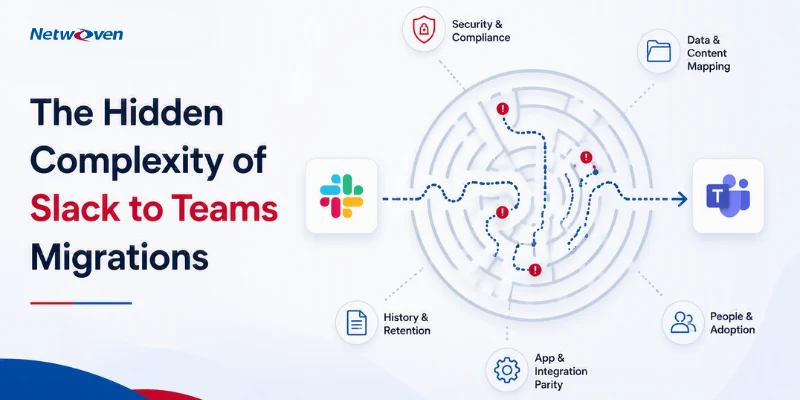
Microsoft has launched its own native Slack-to-Teams migration tool inside the M365 admin center, reaching general availability in Q1 2026. It’s free, built into the admin center, and doesn’t require opt-in. That’s a real demand shock for a page selling third-party migration services – a meaningful share of searchers who used to look for vendors like Netwoven are now searching for how to use Microsoft’s own tool instead, or landing on pages that explain its gaps rather than pages that sell an alternative.
The upside: competitors (CloudFuze, Cloudiway, AdminDroid, office365itpros) are already publishing fresh content specifically framed around “Microsoft’s native tool vs. third-party” and “what the native tool doesn’t cover” – and ranking for it. Netwoven’s own comparison page already makes this exact argument (DMs, velocity, Shared Channels, security perimeter) – but that content and positioning need to be surfaced much more aggressively across the funnel, not just live on one comparison sub-page.
Here is a gap analysis or comparison report aimed at providing some additional publishable assets.
Gap Analysis Report
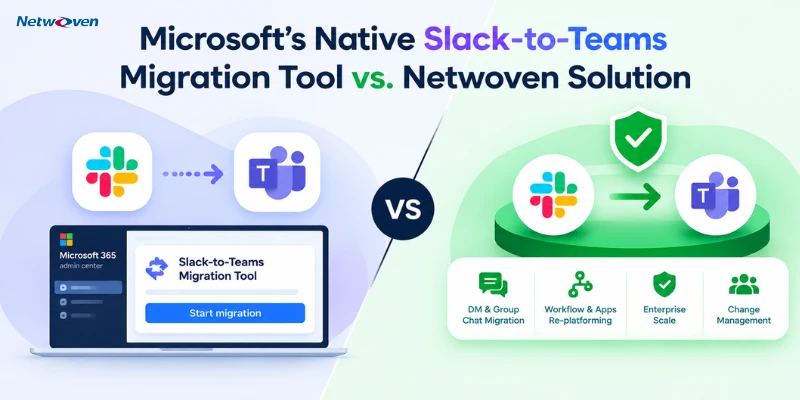
Microsoft’s Native Slack-to-Teams Migration Tool vs. Netwoven Managed Migration Service
Prepared: August 2026 | Based on publicly available product documentation and the Netwoven Slack-to-Teams solution page
Executive Summary
Microsoft introduced a native Slack-to-Teams migration tool inside the Microsoft 365 admin center, reaching general availability in the first quarter of 2026. The tool is free, requires no opt-in, and gives administrators a straightforward path to move Slack public, private, and shared channel content into Microsoft Teams.
This is a meaningful shift for the migration market: a large share of channel-only migrations that previously required a paid tool or vendor can now be handled natively. However, the native tool’s scope is intentionally narrow. It does not migrate direct messages or group chats, does not carry over Slack Workflow Builder automations, apps, or bots, and offers no assessment, change management, or delivery support.
Netwoven’s managed migration service is built to close exactly these gaps – full-fidelity DM and group chat migration, workflow and app re-platforming to Power Automate, enterprise scale throughput, algorithmic information architecture mapping, and structured change management – delivered as an end-to-end engagement rather than a self-service tool.
The sections below lay out the gap analysis in detail, followed by guidance on when the native tool is sufficient on its own and when it is not.
Feature-by-Feature Gap Analysis
| Capability | Microsoft Native Tool | Netwoven Managed Migration | Gap / Business Impact |
|---|---|---|---|
| Service model | Self-service admin tool; no delivery team, strategy, or support included. | End-to-end white-glove service: strategy, execution, adoption/change management, and Hypercare. | Organizations doing DIY migrations absorb all planning, risk, and support burden themselves. |
| Direct messages (1:1) | Not supported. Channel content only. | Fully migrated into Teams Chat with full authorship, no end-user consent required. | Major gap. Conversational history and decisions held in DMs are stranded or lost. |
| Group DMs | Not supported. | Fully migrated into Teams group chats with authorship preserved. | Same conversational-continuity gap as 1:1 DMs. |
| Public / Private / Shared channels | Supported as destination types; channels mapped manually or via CSV into new or existing Teams. | Full support for all channel types, with Shared Channels favored as the modern target architecture, into new and existing Teams/channels. | Native tool covers the basics here; gap is narrower than for DMs, mainly around Shared Channels architecture and scale of mapping. |
| Threaded messages, reactions, formatting | Preserved: threading, standard reactions, formatting, mentions, links, media. | Preserved with full fidelity across all channel types and DMs. | Comparable for channel content; native tool’s coverage does not extend to DMs. |
| Author & timestamp fidelity | Preserved for channel messages (created-by, created-date metadata). | Full authorship and timestamp fidelity across all channel types and DMs. | Comparable for channels; native tool cannot extend this to DMs since DMs aren’t migrated. |
| File attachments | Migrated. | Migrated. | No material gap. |
| Canvas & list content | Converted into HTML/JSON file attachments, not native Teams content. | Not separately published on Netwoven’s page; would need confirmation with delivery team. | Native tool’s canvas handling is a lossy conversion, not a native reproduction. |
| Slack Workflow Builder automations | Not supported. | Re-platformed to Power Automate, with advisory, code samples, and office hours for app/workflow owners. | Significant gap for any organization with embedded Workflow Builder automations or bot-driven approvals. |
| Apps, bots, and integrations | Not supported. | Bot content migrated; apps/integrations re-platformed to Power Automate and Teams customizations. | Same class of gap as workflows — business processes built on Slack apps do not carry over natively. |
| Multi-workspace / Enterprise Grid | Not clearly documented for multi-workspace scenarios; built around a single Slack export package per run. | Full multi-workspace and Enterprise Grid support. | Larger enterprises with multiple Slack workspaces face added complexity running the native tool repeatedly. |
| Migration velocity / scale | Throughput not publicly specified; ingestion is export-package based (manual export, upload, then processed by the tool). | Enterprise-grade throughput; 10M–30M+ messages per week, published as 2x–40x faster than competing tools. | For very large workspaces, native tool timelines and manual export handling are harder to predict at scale. |
| Security & data handling | Slack export package uploaded by the customer to their own Azure Blob Storage; processed by the Microsoft service. | 100% tenant-bounded execution — identities, compute, and storage run inside the customer’s own Azure subscription and M365 tenant; least-privilege model. | Both keep data inside the customer’s environment; Netwoven publishes a more explicit least-privilege operating model. |
| Consent requirements | Initial Global Administrator consent required once; can then be run under narrower roles (e.g., Migration Administrator). | No end-user consent required, including for DM/GM migration. | Not a major gap for channel-only scope; becomes relevant only if a vendor’s DM migration approach requires broad end-user consent, which Netwoven avoids. |
| Information architecture & mapping | Manual mapping of Slack channels to Teams/channels via UI or CSV. | Algorithmic/statistical grouping of Slack channels into an optimal Teams and Shared Channels structure. | Native tool mapping is manual and linear; large channel counts increase planning effort without automated grouping. |
| Assessment & analytics | Not published as part of the tool. | Power BI-based insights on channels, messages, users, apps, and workflows; a structured methodology to decide what to migrate, rebuild, archive, or retire. | Native tool offers no built-in decisioning support for what should or shouldn’t move. |
| Change management & adoption | Not included. | Migration Help Center template, AI Help Agent for self-service support, training, UAT facilitation, and communication kits. | Native tool leaves user readiness and adoption entirely to the customer. |
| Cost | Free, included in Microsoft 365. | Paid managed service (pricing not published). | This is a genuine Microsoft advantage for simple, channel-only, cost-sensitive migrations. |
| Availability / maturity | Reached general availability in the Microsoft 365 admin center in the first quarter of 2026; still a first-generation, evolving capability. | Positioned as a mature, multi-year specialized offering (7+ years of Slack migrations cited). | Native tool is new and its roadmap for DMs/workflows is not yet publicly committed. |
Where the Native Tool Is Sufficient
For a specific and fairly common scenario, Microsoft’s native tool is a reasonable, low-risk starting point:
- Organizations with channel-only Slack usage — little or no reliance on DMs, group chats, workflows, or bots.
- Smaller workspaces where manual channel-to-Teams mapping via the admin UI or CSV is manageable.
- Cost-sensitive projects where a free, Microsoft-supported tool outweighs the value of a managed service.
- Organizations comfortable running the migration themselves, including handling the Slack export/upload process and any resulting sign-in or continuity issues without dedicated support.
Where the Native Tool Falls Short
1. Conversational completeness
Direct messages and group chats are not migrated at all. For most enterprise Slack deployments, a significant share of day-to-day decisions and context lives in DMs rather than channels — leaving this content behind creates real gaps in institutional knowledge, onboarding continuity, and potentially compliance/eDiscovery coverage if Slack is deactivated shortly after migration.
2. Business process continuity
Slack Workflow Builder automations, custom apps, and bots are platform-specific and are not carried over by the native tool. Any organization that has built approval chains, notifications, or integrations on top of Slack will need to rebuild these manually or find a partner to re-platform them — this is precisely the gap Netwoven’s Power Platform re-platforming work is designed to close.
3. Scale and predictability
The native tool is built around a manual export-package workflow: an administrator exports Slack data, uploads it to Azure Blob Storage, and the tool ingests and maps it. Published throughput figures are not available, and the process does not appear optimized for very large or multi-workspace (Enterprise Grid) environments, where a purpose-built, high-velocity pipeline matters more.
4. Planning, mapping, and governance
Channel-to-Teams mapping in the native tool is manual, done channel by channel or via CSV. There is no built-in assessment layer to help decide what should be migrated, rebuilt, archived, or retired, and no analytics on channel activity, ownership, or redundancy to inform that decision.
5. Change management and adoption
The native tool moves data; it does not address user readiness. There is no change-management framework, training content, or support model included, which means organizations are responsible for their own communication plan, helpdesk readiness, and user adoption strategy.
Business Risk Summary
Relying solely on the native tool without accounting for its gaps creates risk in a few specific areas:
- Loss of conversational history and context held in DMs and group chats, with no native recovery path.
- Broken or abandoned business processes where Slack Workflow Builder or bots were load-bearing.
- Unplanned timeline risk on large or multi-workspace environments where manual export/mapping does not scale predictably.
- Low user adoption and support escalations if change management and training are not addressed separately.
- Potential compliance exposure if Slack is decommissioned before DM/GM content is archived through another means.
Recommendation
The right approach depends on migration scope. For small, channel-only Slack environments with minimal automation, the native tool is a credible, no-cost first option. For any organization with meaningful DM/GM usage, embedded Workflow Builder automations or bots, multiple Slack workspaces, or a need for structured change management and support, a managed migration approach – such as Netwoven’s – closes gaps the native tool does not currently address.
A practical middle path for some organizations is a hybrid approach: use the native tool for straightforward channel content while engaging a managed service for DM/GM migration, workflow re-platforming, and adoption support. This should be evaluated case by case against the organization’s actual Slack usage patterns. For a side-by-side view of native, ISV, and managed options, see the Slack to Teams migration tool comparison.
Notes & Sources
This analysis is based on Microsoft’s published documentation and product announcements for the Slack to Teams migration tool (Microsoft 365 admin center, Microsoft Learn, and Microsoft Tech Community, as of August 2026), independent reporting on the tool’s rollout and limitations, and Netwoven’s published Slack-to-Teams migration solution page. Microsoft’s native tool is a first-generation capability and its scope may expand over time; this report should be refreshed periodically as the tool evolves.