The Morning the Math Changed
A CISO at a Fortune 500 financial services firm walked into her Monday standup last month with a single article pulled up on her phone.
“Anthropic’s new model just found a 27-year-old vulnerability in OpenBSD.”
The room went quiet. OpenBSD is one of the most security-hardened operating systems on the planet. It runs firewalls. It runs critical infrastructure. And a flaw that had survived nearly three decades of human security review was discovered by an AI in a matter of days.
“What’s our exposure?” the CISO asked her AppSec lead.
“To OpenBSD specifically? Almost zero. We don’t use it.”
“That’s not what I’m asking.”
The room stayed quiet. Because what she was really asking was this: if an AI can find a 27-year-old bug in the most reviewed code on Earth, what is sitting inside our own codebase right now? And how long until the people who don’t have our interests at heart have the same capability?
Six weeks later, OpenAI launched Daybreak. The math had shifted again.
The Week That Changed AI Cybersecurity
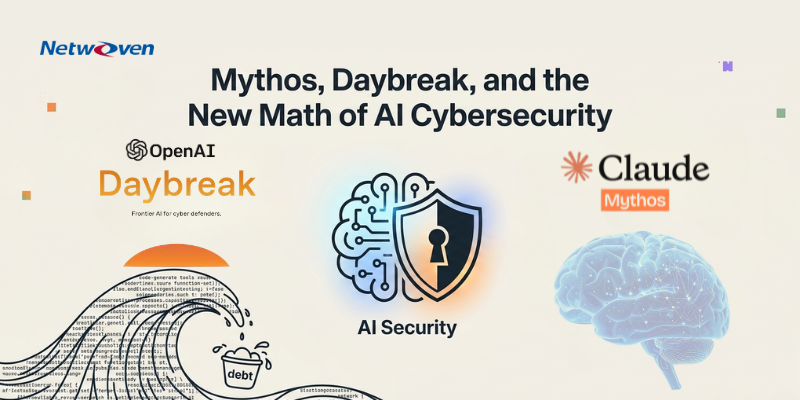
In April 2026, Anthropic publicly announced Claude Mythos Preview under an initiative called Project Glasswing. In May 2026, OpenAI followed with Daybreak, built on GPT-5.5-Cyber and Codex Security. In six weeks, the two largest AI labs in the world both shipped AI cybersecurity platforms aimed at enterprise defenders.
That timing is not a coincidence. It is a signal.
For the last two years, AI labs have been quietly tracking the same trendline: the same models that make developers more productive at writing code are also getting better at finding flaws in code. Anthropic’s own published research suggests these capabilities emerged as a downstream consequence of general improvements in reasoning and autonomy, not as a deliberate training objective. In other words, this was not the goal. It is the result.
For security leaders, the practical implication is straightforward: the era of AI-powered vulnerability discovery has arrived, and it is going to be deployed by both defenders and attackers. The question is whether your security strategy is calibrated for it.
What Is Claude Mythos?
Claude Mythos Preview is an unreleased frontier AI model from Anthropic, designed for autonomous software vulnerability discovery and exploitation. It can analyze codebases, identify complex flaws including memory safety violations, and in some cases generate working exploits. Anthropic has restricted access to roughly 40 critical-infrastructure partners under Project Glasswing because the model is considered too dangerous for broad release.
A few facts worth knowing:
- It found a 27-year-old vulnerability in OpenBSD, an operating system widely considered among the most security-hardened in the world.
- It has surfaced thousands of high-severity vulnerabilities across major operating systems and web browsers.
- It can both find and exploit vulnerabilities, which is why Anthropic deemed it too risky to release publicly.
- Access partners include Apple, Google (via Vertex AI), and approximately 40 organizations that maintain critical software.
- Anthropic describes the capabilities as a “watershed moment” for cybersecurity.
What Is OpenAI Daybreak?
OpenAI Daybreak is a cybersecurity initiative launched in May 2026, combining GPT-5.5 models with Codex Security, OpenAI’s agentic application security framework. It is designed to help defenders find, validate, and patch software vulnerabilities by integrating AI-powered analysis directly into the software development lifecycle. Unlike Mythos, Daybreak is publicly available, with companies able to request a security assessment.
Daybreak’s structure has three model tiers, each with progressively stronger access controls:
| Tier | Use case | Access controls |
| GPT-5.5 | General enterprise and developer work | Standard |
| GPT-5.5 with Trusted Access for Cyber | Defensive workflows: code review, vulnerability triage, malware analysis, patch validation | Verified |
| GPT-5.5-Cyber | Authorized red-teaming, penetration testing, controlled validation | Strongest, with identity verification |
The agentic harness is Codex Security. It builds a codebase-specific threat model, identifies realistic attack paths, validates issues in isolated environments, and proposes patches for human review.
Partners already integrated at launch include Cloudflare, Cisco, CrowdStrike, Oracle, Zscaler, Palo Alto Networks, and Akamai – a who’s-who of enterprise security infrastructure.
How Do Mythos and Daybreak Compare?
The two products target overlapping ground but reflect fundamentally different access philosophies.
| Dimension | Anthropic Mythos | OpenAI Daybreak |
| Launched | April 2026 | May 2026 |
| Access | Restricted to ~40 critical-software partners | Publicly available with request-based assessment |
| Primary focus | Autonomous vulnerability discovery at scale | Defense-by-design integration into the SDLC |
| Posture | Dual-use (find and exploit) | Defense-focused, with offensive tier for authorized red-teaming |
| Agentic framework | Direct model access | Codex Security |
| Workflow | Standalone model access for vetted partners | Built to fit existing software development pipelines |
The short version: Mythos is the “this is dangerously capable, so we are rationing access” story. Daybreak is OpenAI’s bid to put cyber-defense AI into the daily dev loop more broadly.
Both matter. Both are signals that the asymmetry between offense and defense in cybersecurity is about to shift dramatically.
Why This Matters Now: The AI Tech Debt Timer
If Mythos and Daybreak were happening in isolation, they would be interesting. They are not happening in isolation.
Gartner has put three numbers on the table that every CISO and CIO should be paying attention to:
- 2,500% projected increase in software defects from prompt-to-app development by 2028
- 33% of all IT work will go to remediating AI data debt to secure AI by 2030
- 40% of AI-augmented coding projects will be canceled by 2027 due to escalating costs and weak risk controls
Put differently: organizations are creating roughly a decade’s worth of conventional technical debt inside a single year. And most of that debt is sitting in AI-generated code that no one reviewed.
GitClear’s analysis of 211 million lines of real-world code already shows the pattern emerging:
- 60% less refactored code
- 48% more copy-paste patterns
- Code churn doubled
Now imagine an attacker pointing a Mythos-class model at that codebase.
The Asymmetry Problem
Here is the core of what changed in the last six weeks.
For most of cybersecurity’s history, the defender’s economics have been worse than the attacker’s. The defender has to be right every time. The attacker only has to be right once. The defender has to scale across an entire estate. The attacker can specialize.
AI promised to flip that. AI-powered defenders can scan an entire codebase faster than attackers can probe it. AI-powered patch generation can close gaps before exploit kits arrive.
But AI also helps the attacker. Bigger codebases. Faster discovery. Higher-quality exploits. And critically, AI does not care about your governance review board.
The strategic question for security leaders is no longer “how do we use AI to defend ourselves?” It is “how do we close the gap before attackers do?”
This is what Daybreak and Mythos make tangible. The capability is here. The race for parity is on. And the longer your AI-generated code sits unreviewed in production, the worse your math gets.
What Should CISOs Do This Quarter?
Four concrete actions worth taking before the next board meeting.
1. Inventory your AI-generated code exposure
✋ You probably do not know how much of your codebase was written by AI in the last 12 months, and you almost certainly do not know how much of that was meaningfully reviewed before merge.
Action: Work with engineering leadership to get an honest read on:
- What percentage of new code is AI-generated (Copilot, Cursor, Claude Code, ChatGPT-assisted)
- What your current review and merge policy is for AI-assisted commits
- Whether your AppSec tooling can flag AI-generated code patterns
2. Govern AI-generated code at development time, not in production
📊 The “ship fast, fix later” model breaks when “later” arrives with thousands of zero-days.
Action: Stand up explicit governance for AI-generated code:
- Architectural checkpoints for AI-assisted components
- Quality gates that AI output must pass before merge
- Human review for any code touching authentication, data access, or external interfaces
- Audit trails for AI-assisted commits
3. Threat-model the pipeline, not just the application
⚠️ AI development tools are themselves attack surfaces. Prompt injection in your dev tools, training data poisoning, model exfiltration, MCP server compromise – these are not theoretical.
Action: Extend your threat modeling to cover:
- The AI development tools your engineers use
- The agents and MCP servers integrated into your stack
- The flow of proprietary code and data into AI services
- The governance model for AI agent deployment
4. Match AI-powered defense to AI-powered offense
⚖️ You cannot compete with AI-assisted attackers using human-only defense at human speed.
Action: Evaluate AI-powered defenders for your environment:
- Code review and patch validation tools (Daybreak partners, native Microsoft Security Copilot, third-party options)
- AI-powered threat detection and response
- Continuous security validation rather than periodic audits
- Identity and access governance built for AI agent deployment
The Compliance and Microsoft Stack Implications
For Netwoven clients operating in the Microsoft ecosystem, two further implications are worth flagging:
Microsoft Security Copilot is now a directly relevant defender. If you have been deferring a Security Copilot evaluation, the Mythos and Daybreak news is the forcing function. The capabilities OpenAI and Anthropic are building externally will appear inside the Microsoft security stack over the coming quarters.
Agentic AI compliance is no longer optional. Whether you are deploying Copilot agents, MCP-based integrations, or custom Azure OpenAI workflows, the governance posture you build now becomes your audit defense later. SOC 2, ISO 27001, HIPAA, and GDPR all require demonstrable controls over data access. AI agents that read across your data without enforced governance are control gaps.
Frequently Asked Questions
Claude Mythos is Anthropic’s restricted-access vulnerability discovery model, available only to ~40 critical-infrastructure partners. OpenAI Daybreak is a publicly available cybersecurity platform built on GPT-5.5-Cyber, designed to integrate AI-powered security directly into the software development lifecycle. Mythos is more capable but harder to access; Daybreak is more practical for most enterprise security teams.
Recent research suggests yes, in two ways. First, AI-generated code introduces more subtle, context-deficient flaws that are syntactically correct but architecturally unsound. Second, AI-assisted development encourages copy-paste patterns and reduces refactoring, which compounds technical debt. Gartner projects a 2,500% increase in software defects from prompt-to-app development by 2028.
Three immediate priorities: (1) inventory how much of your codebase is AI-generated and unreviewed, (2) stand up governance for AI-assisted development at the time code is written, not in production, and (3) evaluate AI-powered defensive tools to match the AI-powered offensive capabilities that adversaries will increasingly have. Match the speed of AI offense with the speed of AI defense.
AI coding tools generate code that is usually syntactically correct but often lacks awareness of the broader system architecture, business rules, and security context. The result is “context-deficient” flaws: subtle logic errors, missing input validation, broken authorization patterns, and unsafe defaults that pass standard static analysis but fail under adversarial probing. These flaws compound when AI output is rubber-stamped into production without human security review.
Yes, and increasingly so. AI-powered vulnerability discovery has demonstrated the ability to find flaws that human security researchers and traditional static analysis tools have missed for decades. Tools like Codex Security build a codebase-specific threat model and identify realistic attack paths. The same capability is also being developed by adversaries, which is why proactive evaluation has a time advantage.
Where Netwoven Comes In
Netwoven helps enterprise teams build AI security and governance frameworks that match the pace AI development has introduced. Our work in this space includes:
- AI Security Risk Assessment – a focused engagement to identify and prioritize AI-related vulnerabilities across your Microsoft environment
- AI governance frameworks – policy, controls, and audit infrastructure built for Microsoft 365, Azure AI, and Copilot deployments
- Threat modeling for AI-assisted development – extending your existing AppSec program to cover the AI development pipeline
- Microsoft Security Copilot evaluation and deployment – matching AI-powered defenders to your specific environment
As a Microsoft Solutions Partner with 25 years of security and AI transformation experience, we sit at the intersection of where the Mythos and Daybreak story matters most: the Microsoft stack that most enterprises actually run on.
📅 Schedule a 30-minute AI security consultation – we will review your current posture and identify the highest-leverage actions for your environment.
Or reach out directly: info@netwoven.com