Introduction
Search has rewritten itself. Paid is inflating. Content production can no longer keep pace with publishing demand. And the AI license your team already pays for is sitting at single-digit active usage.
This guide is for marketing leaders who need to understand what just happened to their channel mix – and what the new operating model actually looks like. It draws on industry research from Seer Interactive, Semrush, Advanced Web Ranking, and Google’s own AI Mode data, and on the operating-model framework Netwoven uses with customers adopting Microsoft 365 Copilot and Claude into their marketing function.
You’ll learn:
- Why the marketing landscape has structurally shifted in the last 18 months
- The triple squeeze on organic, paid, and brand that’s compressing marketing margins
- The “AI paradox” that explains why most teams are licensed but not operating with AI
- The shift from AI as a drafting partner to AI as a channel operator
- The three modes of AI in marketing (Generative, Orchestrated, Agentic) and the Crawl-Walk-Run framework that maps to them
- Six marketing activities that fundamentally change when AI pulls signal across the stack
- How to choose between Microsoft 365 Copilot and Claude (or both) for your marketing automation
Why the Marketing Landscape Just Rewrote Itself
The shift isn’t gradual. Four data points define the new reality:
- AI Overviews dropped organic click-through rate by 61% when they appear on a search results page, according to a 2026 Seer Interactive study of 5.47 million queries.
- 48% of Google queries now show an AI Overview, up from 31% a year earlier. [Advanced Web Ranking, March 2026]
- 93% of searches in Google’s AI Mode end without a click. Across Google overall, 60% of searches now end without a click. The overlap between traditional top 10 rankings and AI citations has collapsed from 75% to 17-38%. Ranking is no longer the same as being cited.
The bottom line: search hasn’t shrunk. It has bifurcated. Visibility now means two different things – appearing in the traditional blue links and being cited in the AI-generated answer. The team that wins both is going to win the channel; the team that wins only one will quietly lose share.
AI Overview is the headline change, but it’s not the only one. Paid is moving in the wrong direction too, and the content function has hit a ceiling.
The Triple Squeeze: Three Forces Pressing Marketing Margins at Once
The pressure isn’t coming from a single direction. It’s coming from three.
The Triple Squeeze on Marketing:
- Organic clicks compressed (61% CTR drop)
- Paid CPC inflation (+12.9% YoY, +41% software/tech)
- Brand content demand exceeds supply
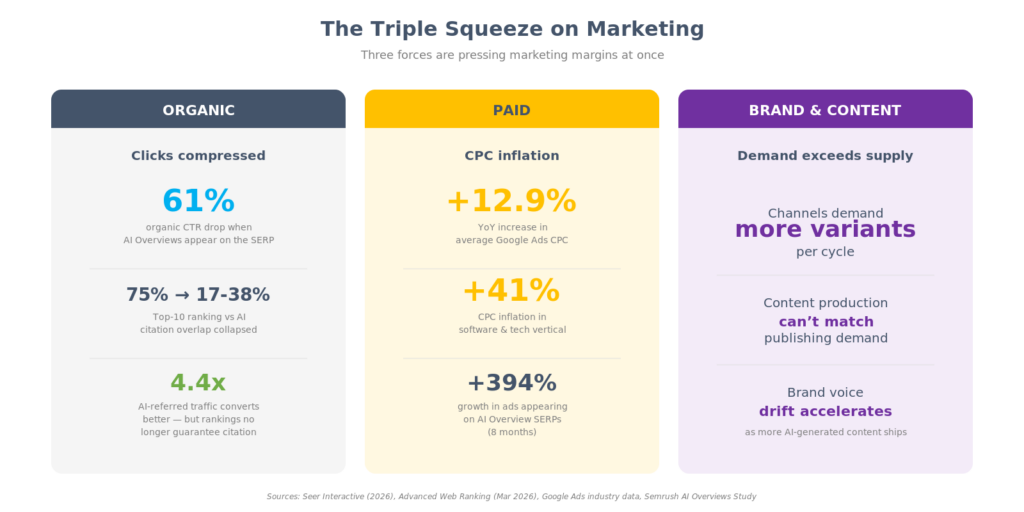
- Organic – clicks compressed. The 61% CTR drop on AI Overview SERPs is the largest near-term hit. The ranking-vs-citation overlap collapse is the longer-term structural one. AI-referred traffic does convert ~4.4x better than traditional organic, but only if you’re being cited – and rankings no longer guarantee citation.
- Paid – CPC inflation. Average Google Ads CPC is up ~12.9% year-over-year. The software and tech vertical has seen ~41% inflation. Ads now appear in ~25.6% of AIO SERPs, up ~394% in eight months. The paid channel is doing more work to deliver less click.
- Brand & Content – demand exceeds supply. Channels (SEO, AEO, SEM, social) need more variants per cycle than ever. Content production can’t match publishing demand. And brand voice drifts faster as more AI-generated content ships across the surface area.
These three forces compound. If your operating model was already strained by content production demand a year ago, it’s now compressed simultaneously by organic CTR, paid CPC, and brand-voice consistency. No amount of “work harder” closes that gap. The work itself has to change.
The AI Paradox: Licensed Everywhere, Operating Nowhere
There’s an obvious tool to close the gap: AI. Most marketing teams already pay for it.
- Microsoft 365 Copilot has 15M+ paid seats globally. Active usage hovers around 36%. In marketing teams, that gap tends to be wider.
- About 3.3% of all M365 users actually pay for Copilot, suggesting the rollout is still concentrated.
- 44.2% of lapsed Copilot users cite distrust of AI answers as a reason for stopping.
- More than 230,000 organizations are now using Copilot Studio to build custom agents
The same pattern holds for other models. Teams have ChatGPT Enterprise, Claude, Gemini, or some combination. The licenses are paid for. The data residency, AI governance, and Microsoft Purview controls already meet enterprise standards. What’s missing is the operating model that turns AI from a drafting tool into the operator of channels.
This is the AI paradox. The technology is in place. The procurement is done. The team is using it for blog drafts and meeting summaries. None of that touches the triple squeeze. The transformation isn’t a buying decision; it’s an operating-model decision.
From Drafting Partner to Channel Operator: The FROM/TO Shift
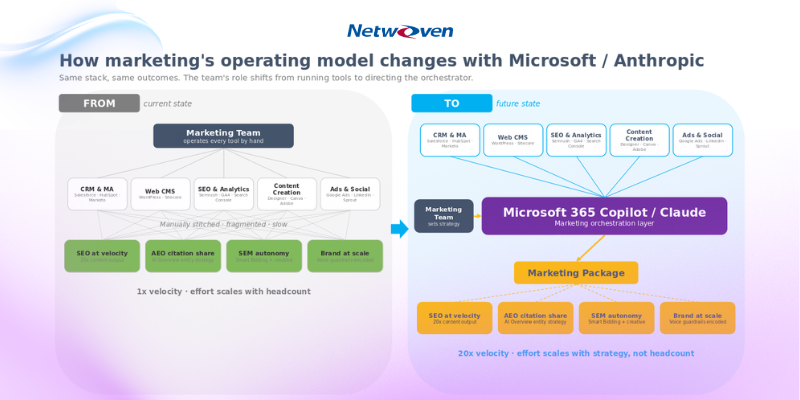
Look at the hero image at the top of this guide again. It’s not just a diagram – it’s the operating-model question every marketing leader has to answer in 2026.
The FROM state is what most marketing teams look like today. One team operates five tools by hand: CRM and marketing automation, web CMS, SEO and analytics platforms, content-creation tools, and ad and social platforms. Outcomes get produced – SEO content, AEO citation work, SEM creative, brand assets – but every one of them is manually stitched across the disconnected stack. Effort scales with headcount. Velocity is 1x.
The TO state doesn’t replace the stack. It connects it. The same five source systems feed into an orchestration layer – Microsoft 365 Copilot, Claude, or both – that the marketing team directs. The team sets strategy, brand voice, and guardrails. The orchestrator runs the workflows. The same outcomes still ship. The only thing that’s changed is who’s operating the tools, and how the work composes across them.
The economic shape of the change is the headline:
| Operating model | Velocity | Effort scales with |
| FROM (manual) | 1x | Headcount |
| TO (orchestrated) | 20x | Strategy, not headcount |
The team doesn’t get smaller. The team’s role shifts. Less time stitching tools together. More time on what to say and why, and on the brand and customer judgments that an AI can’t make.
The Orchestration Layer: How AI Connects the Marketing Stack
The word “orchestration” gets overused in AI marketing. Here’s what it actually means in practice.
An orchestration layer is the connective tissue that pulls signal from across your stack, composes multi-step workflows that span drafting / publishing / schema / ad management / reporting, and produces unified marketing outputs without a human manually stitching the work between tools.
In a Microsoft 365 environment, the orchestration layer is built from three pieces you almost certainly already license:
- Microsoft 365 Copilot as the conversational interface and reasoning layer
- Copilot Studio as the agent-definition layer for multi-step, scheduled, or triggered workflows
- Microsoft Graph and Copilot Connectors as the integration plane into CRM, CMS, analytics, and ad platforms
For organizations that want long-context analysis and writing in addition to tenant-bound orchestration, Claude (from Anthropic) often sits alongside Copilot. Claude excels at long-document reasoning and writing in a captured voice. Copilot excels at tenant-bound work that touches Purview-governed data. The best AI marketing stacks use both, with each model doing the job it’s actually best at.
What flows through the orchestration layer:
- Inputs – CRM lead-state changes, CMS content inventory, GA4 and Search Console performance data, Semrush keyword portfolios, AI Overview citation tracking, ad-platform performance, brand-voice prompt library, ICP and positioning documents.
- Workflows – SERP analysis → brief → draft → schema → internal linking → publication queue. Or: GA4 performance → low-performer identification → refresh drafts → WordPress queue → re-monitor.
- Outputs – Published pages, refreshed pages, ad variants, schema markup, FAQ blocks, internal-linking maps, performance dashboards.
The marketing team sets policy. The orchestration layer composes the work.
Three Modes of AI in Marketing: Generative, Orchestrated, Agentic
AI in marketing isn’t one capability. It’s three, on a maturity curve.
Three Modes of AI in Marketing: Generative (one tool, one task), Orchestrated (multi-tool, multi-step), and Agentic AI (autonomous, goal-directed)
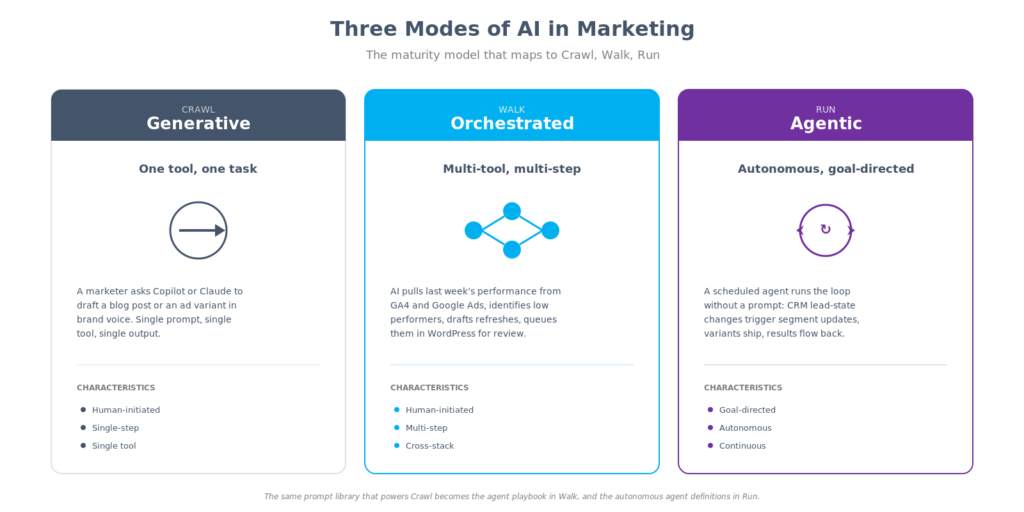
Generative – one tool, one task
A marketer asks Copilot or Claude to draft a blog post or an ad variant in brand voice. Single prompt, single tool, single output. This is where most marketing teams are today. It’s useful, but it’s drafting-faster. It doesn’t change the operating model.
Characteristics: human-initiated, single-step, single-tool.
Orchestrated – multi-tool, multi-step
AI pulls last week’s organic and paid performance from GA4 and Google Ads, identifies low-performing pages, drafts refreshes, generates updated schema, and queues everything in WordPress for human review. One marketer triggers the workflow; the orchestrator does the cross-stack work.
Characteristics: human-initiated, multi-step, cross-stack.
Agentic – autonomous, goal-directed
A scheduled Copilot Studio agent runs the loop without a prompt. A CRM lead-state change triggers a segment update. A personalized variant ships to retargeting. Results flow back into the CRM and feed back to the next iteration. Humans review exceptions, not every step.
Characteristics: goal-directed, autonomous, continuous.
The three modes aren’t competing – they’re sequential. The same prompt library that powers Generative becomes the agent playbook in Orchestrated, and the autonomous agent definitions in Agentic. Each phase reuses the team’s accumulated brand-voice and process work; nothing gets thrown away when you move up the curve.
The Crawl, Walk, Run Framework
Three modes of AI map cleanly onto a three-phase rollout. Netwoven calls it Crawl-Walk-Run; the structure is what matters, not the name.
Crawl, Walk, Run timeline: Months 0-6 (Crawl, 2-3x velocity), Months 6-18 (Walk, 5-10x velocity), Months 18+ (Run, 20x velocity)
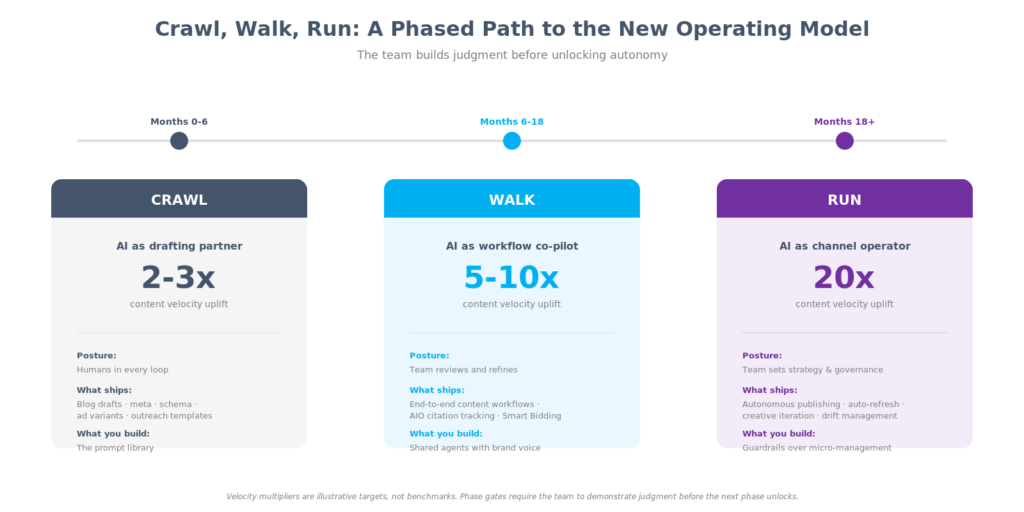
Crawl – Months 0 to 6 (AI as drafting partner)
Posture: humans in every loop. Velocity uplift (illustrative): 2-3x.
Copilot or Claude drafts blog posts, meta tags, ad variants, FAQ schema, outreach templates. Humans approve every piece that ships. The most important work of this phase isn’t the drafts themselves – it’s the prompt library. Brand voice, ICP, vocabulary, content templates, do-not-say lists. The library you build in Crawl is the asset that compounds in Walk and Run.
Most teams that stop here describe AI as “useful but not transformative.” That’s the right description for Crawl. Crawl is preparation. The transformation is in what Crawl unlocks.
Walk – Months 6 to 18 (AI as workflow co-pilot)
Posture: team reviews and refines. Velocity uplift (illustrative): 5-10x.
End-to-end content workflows run as one orchestrated process: SERP analysis, brief, draft, schema, internal linking, publication queue. AI Overview citation share gets tracked and refreshed on a regular cadence. Smart Bidding across Google Ads, LinkedIn Ads, and retargeting runs with AI orchestration. Brand voice lives in shared Copilot Studio agents.
The marketing team’s job in Walk is review and refine. The orchestrator does the cross-stack composition; the team validates the strategic judgment behind each output. This is the phase where the gap between AI-enabled teams and AI-licensed-but-not-operating teams becomes visible in the numbers.
Run – Months 18+ (AI as channel operator)
Posture: team sets strategy and governance. Velocity uplift (illustrative): 20x.
Inside documented guardrails, agents publish and refresh pages on SERP changes without per-page approval. AEO strategy continuously optimizes as the SERP shifts. Paid channels run with autonomous bid management and creative iteration. Brand guardrails are encoded. AI manages drift exceptions; humans set strategy and resolve edge cases.
Run is not unsupervised AI. Run is supervised AI within encoded guardrails. The supervision moves from per-piece review to policy-level governance – which is the job marketing leadership was always supposed to be doing.
Why the phases matter
You can’t skip Crawl. You especially can’t skip Walk. Teams that try to go from Generative use straight to Agentic without building the prompt library, the brand-voice agents, or the team’s judgment-development period inevitably end up rebuilding the work at higher cost six months later.
Phase gates are not arbitrary. Each phase produces specific artifacts (the prompt library in Crawl, the orchestrated workflows in Walk, the agent playbook in Run) that the next phase requires.
Six Marketing Activities, Reimagined
The clearest way to see how the operating model changes is to walk through the activities marketing teams actually do every week.
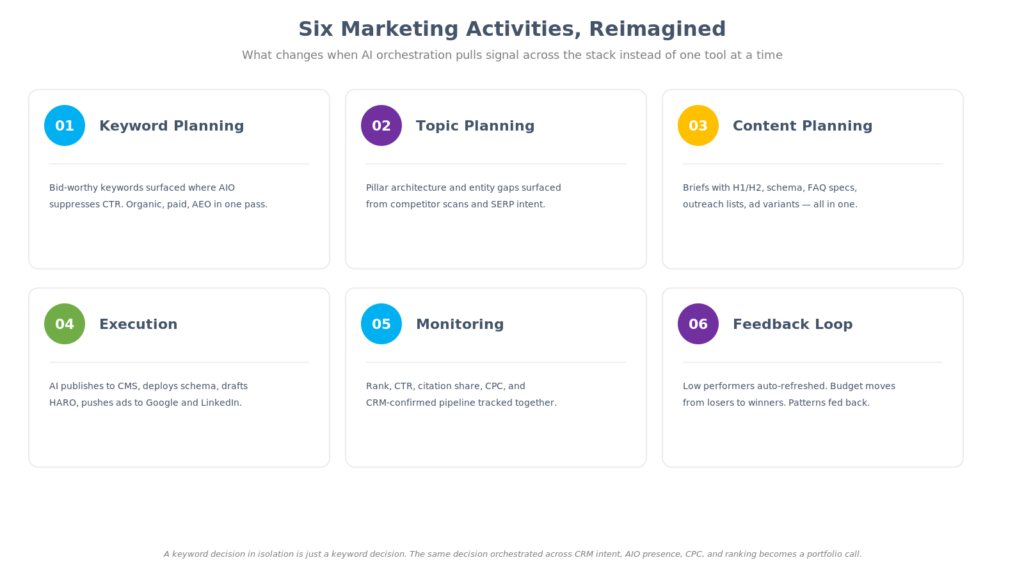
Six Marketing Activities Reimagined: Keyword Planning, Topic Planning, Content Planning, Execution, Monitoring, and Feedback Loop, each transformed when AI orchestrates across the stack
1. Keyword Planning
In the old model: pick keywords from a search-volume report, hand to content. In the new model: bid-worthy keywords surfaced where AI Overviews suppress organic CTR, routed across organic, paid, and AEO in one pass. A keyword decision in isolation is just a keyword decision. The same decision orchestrated across CRM intent, AIO presence, paid CPC, and ranking becomes a portfolio call.
2. Topic Planning
In the old model: brainstorm topics or copy a competitor list. In the new model: pillar architecture, entity coverage gaps, and linkable-asset topics surfaced automatically from competitor scans and SERP intent analysis. The AI reads what AI Overviews are citing and tells you what’s missing from your entity coverage.
3. Content Planning
In the old model: a brief gets written, a writer drafts, a reviewer reviews. In the new model: a single brief contains H1/H2 structure, schema spec, FAQ block, outreach list, and matched ad copy variants. The brief is the workflow.
4. Execution
In the old model: a content marketer publishes to CMS, a designer makes assets, an ad ops manager pushes campaigns. In the new model: AI publishes to CMS, deploys schema, drafts HARO responses, pushes ad variants to Google, LinkedIn, and retargeting – as one orchestrated step.
5. Monitoring
In the old model: weekly check on rankings and CTR. In the new model: rank, CTR, AI Overview citation share, Core Web Vitals, CPC, and CRM-confirmed pipeline tracked together by page and by campaign. The point isn’t more dashboards. The point is that signal across the stack is now correlated, so a decline in one metric tells you what to fix in another.
6. Feedback Loop
In the old model: a quarterly retro. In the new model: low performers auto-refreshed on SERP shifts. Budget reallocated from CRM-confirmed losers to winners on a continuous cadence. Patterns fed back into the prompt library so the next cycle is better. The feedback loop is the closure of the operating model. Without it, you have orchestration without learning.
Why Tenant-Aware AI Matters: Microsoft 365 Copilot + Claude
A reasonable question: couldn’t we do all of this with a generic third-party LLM and some glue code?
You could try. The reason most enterprises end up landing on Microsoft 365 Copilot – often with Claude alongside it – comes down to five governance properties that compound in any organization that already operates inside Microsoft 365.
- Tenant-bound. Customer data stays inside the M365 tenant. There’s no third-party vendor with a copy of CRM, draft content, or brand voice prompts.
- Purview-governed. Sensitivity labels, DLP policies, and audit trails apply natively. Marketing data inherits the governance posture the rest of the business already lives inside.
- Native integration. Content lives in Word, SharePoint, Teams, Loop, and Designer. The handoff between drafting and review doesn’t require a parallel tool.
- Agent platform ready. Copilot Studio and Microsoft Graph are already built, already governed, and already documented. You don’t have to architect a separate agent runtime.
- Already licensed. If the tenant already pays for Microsoft 365 Copilot, there’s no new license to negotiate, no new vendor SOC 2 to review, and no new DPA to sign.
Claude (from Anthropic) often complements Copilot in this stack. Claude’s strengths – long-context reasoning over tabular data, strong writing in a captured voice, careful analysis of large content sets – make it the right tool for analysis and content-generation work that doesn’t need to touch Purview-governed data. Copilot remains the right tool for tenant-bound orchestration.
The combination – Claude for analysis and writing, Microsoft 365 Copilot for tenant-bound orchestration, the marketing team for strategy and brand judgment – is the AI marketing stack we see working most reliably in enterprise environments.
What This Means for Marketing Leaders
If you’re reading this as a CMO or head of marketing, three takeaways matter more than the rest:
1. Visibility now means two things. Ranking and citation are now separate metrics. Your top commercial keywords likely have two SERP variants – one with an AI Overview, one without – and your performance on each can diverge significantly. Track both.
2. Operating model is the unlock, not tooling. Your team almost certainly already has the AI license. The transformation isn’t in buying more software. It’s in moving the team’s role from operating tools to setting strategy and reviewing AI-drafted artifacts. That’s an organizational change, not a procurement change.
3. Phase discipline beats velocity. The teams that go fastest in Crawl by skipping the prompt library work pay for it in Walk. The teams that try to skip Walk and jump to Run end up rebuilding the agents six months later. Each phase produces specific artifacts the next phase requires. The discipline matters.
If your marketing team’s bottleneck today is “we can’t produce enough content,” reread that sentence. The bottleneck is almost never raw production capacity. The bottleneck is an operating model that requires a human to be in the loop for every piece of work. That’s the model AI marketing transformation changes.
Frequently Asked Questions
AI marketing transformation is the shift from using AI as a drafting assistant inside one tool to using AI as an orchestration layer across the marketing stack. It changes the marketing team’s role from operating tools to setting strategy, brand voice, and guardrails – while AI agents run the cross-stack workflows that produce SEO content, AEO citation work, SEM campaigns, and brand assets. The transformation is structural, not cosmetic; the operating model changes, not just the software list.
AI Overview compresses traditional click-through rates by roughly 61% on the SERPs where it appears, fragments search into two variants (standard SERP and AI Overview SERP) for the same query, and shifts the prize from “ranking in blue links” to “being cited inside the AI answer.” Approximately 48% of Google queries now show an AI Overview, up from 31% a year earlier. The ranking-vs-citation overlap has collapsed from ~75% to ~17-38%, which means traditional SEO investment no longer reliably translates to AI Overview citation.
Answer Engine Optimization (AEO) is the practice of structuring content so that AI-powered answer engines (Google AI Overview, ChatGPT, Perplexity, Claude, Gemini, etc.) can find, extract, and cite it as a source. It overlaps with traditional SEO but adds emphasis on Article and FAQPage schema, entity coverage, question-format H2s, named author attribution, and structured Q&A blocks. AEO is what makes content eligible for citation inside AI-generated answers, which is increasingly where high-intent commercial discovery happens.
Crawl-Walk-Run is a three-phase rollout that builds team judgment before unlocking autonomy. Crawl (months 0-6) uses AI as a drafting partner with humans in every loop, with a 2-3x illustrative velocity uplift. Walk (months 6-18) uses AI as a workflow co-pilot that orchestrates multi-step processes across the stack, with the team reviewing outputs, for a 5-10x illustrative velocity uplift. Run (months 18+) uses AI as a channel operator that runs autonomous workflows inside encoded guardrails while the team sets strategy and governance, for up to 20x velocity uplift.
The three modes are Generative (a marketer asks AI for one thing – single prompt, single tool, single output), Orchestrated (AI runs multi-step workflows across multiple tools when a human triggers it), and Agentic (AI agents run goal-directed workflows autonomously inside guardrails, with humans handling exceptions and strategy). The same prompt library that powers Generative becomes the agent playbook in Orchestrated and the autonomous agent definitions in Agentic.
Microsoft 365 Copilot acts as the tenant-bound orchestration layer for marketing teams that already operate inside Microsoft 365. Combined with Copilot Studio (for agent definitions) and Microsoft Graph plus Copilot Connectors (for stack integration), it pulls signal from CRM, CMS, analytics, and ad platforms; runs orchestrated workflows; and produces outputs inside the organization’s existing Purview governance posture. No customer data leaves the tenant, no parallel data store is required, and the licenses are typically already in place.
Claude (from Anthropic) is typically the stronger choice for long-context reasoning, analysis of large content sets, and writing in a captured brand voice – work that doesn’t need to touch Purview-governed tenant data. Microsoft 365 Copilot is typically the stronger choice for orchestration that touches CRM, SharePoint, Teams, or any data inside the M365 tenant. Most mature AI marketing stacks use both: Claude for analysis and writing, Copilot for tenant-bound orchestration, the marketing team for strategy.
A marketing orchestration layer is the connective tissue across the marketing stack. It pulls signal from analytics, CRM, and SEO tools, composes workflows that span drafting, publishing, schema, ad management, and reporting, and produces unified marketing outputs without a human manually stitching the work together. In a Microsoft environment, Copilot Studio plus Microsoft Graph plus Copilot Connectors form the orchestration layer. In a mixed environment, Claude often sits alongside as the analysis and writing layer.
In most cases, no. If the organization already pays for Microsoft 365 Copilot, Copilot Studio, and Microsoft Graph, the orchestration layer is already licensed. The existing marketing stack – CRM, CMS, SEO tools, ad platforms – keeps doing its job. What changes is who operates it and how the work composes across it. The dominant cost of transformation is operating-model change and prompt-library investment, not new software.
A practical Crawl-Walk-Run rollout takes about 18 to 24 months to fully reach the Run phase, with measurable velocity uplift visible within the first 90 days. The Crawl phase (months 0-6) builds the prompt library and produces 2-3x velocity. The Walk phase (months 6-18) builds orchestrated workflows and produces 5-10x velocity. The Run phase (months 18+) builds autonomous agents and produces up to 20x velocity. The bottleneck is not technical; it’s team judgment development.
The team’s day-to-day shifts from operating tools to setting strategy and reviewing AI-drafted artifacts. Content writers spend more time on positioning, ICP, and brand-voice work and less time on copy-paste between systems. Paid-channel managers spend more time on portfolio strategy and less time on per-variant bid adjustments. Brand consistency stops being a person’s job and starts being a policy encoded in shared agents. The team often becomes smaller in routine production capacity but stronger in strategic judgment.
Track five categories together: (1) content velocity (pieces shipped per cycle), (2) AI Overview citation share (how often your content gets cited by Google’s AI Overview for target queries), (3) paid creative iteration cadence (variants tested per channel per week), (4) brand voice adherence (drift detection across published content), and (5) CRM-confirmed marketing-sourced pipeline. The five together give you a composite that distinguishes orchestration that’s working from orchestration that’s only producing volume.
Where to Go From Here
If your team is at Generative and considering Orchestrated, the practical next step is a structured Discovery engagement: a marketing stack audit, an SEO/AEO/SEM baseline, brand-voice documentation, a Copilot readiness score, and a phased roadmap with measurable success criteria. For qualifying customers, Microsoft co-funds Discovery engagements that scope this kind of rollout.
Netwoven runs these Discovery engagements as part of our Transform with AI services. The output is a phased roadmap your team can execute with us or with another partner – what you keep is the artifacts (the prompt library plan, the agent definitions, the KPI dashboard) regardless of who runs the next phase.
Request a Discovery scoping call →
Related Reading
- Microsoft AI hub – everything we publish on Microsoft 365 Copilot, Copilot Studio, and Purview
- Claude hub – everything we publish on Anthropic Claude in the enterprise
- Transform with AI services – the services pillar for Microsoft and Claude engagements
- Govern 365 – information governance for Microsoft 365
- Netwoven blog – case studies, tactical posts, and field notes
External References
- Seer Interactive – 2026 AI Overviews CTR Study (5.47M-query)
- Semrush – AI Overviews Study
- Advanced Web Ranking – AI Overview Coverage Data, March 2026
- Microsoft 365 Copilot product documentation – aka.ms/copilot
- Copilot Studio – microsoft.com/copilot-studio
- Anthropic Claude – anthropic.com
- Schema markup validator – validator.schema.org
- Google Search Central structured data guidance – developers.google.com/search/docs/appearance/structured-data